
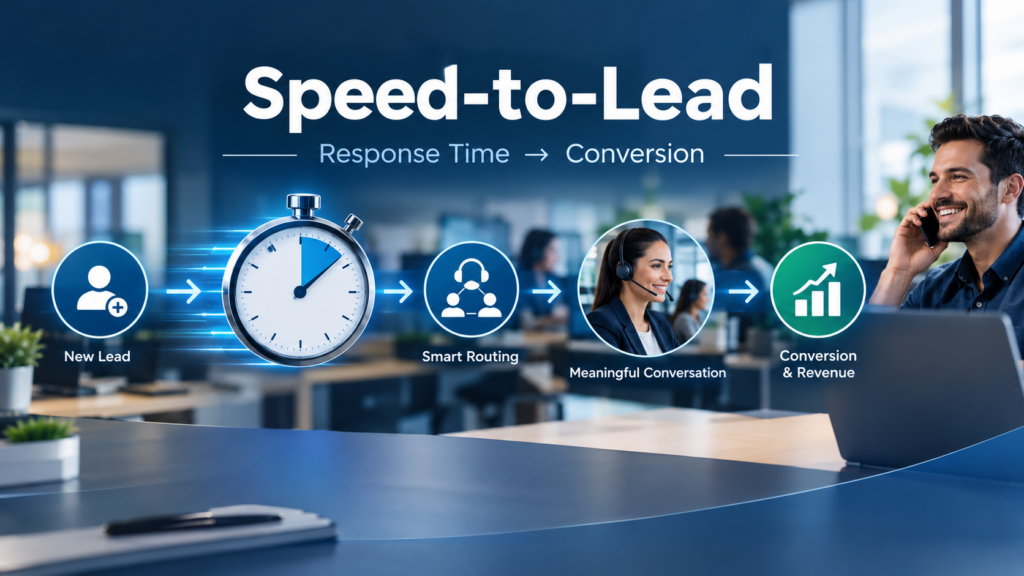
Speed-to-lead is the time between a prospect expressing interest and a business making its first meaningful response. In many lead-driven businesses, that interval can influence whether an opportunity becomes a conversation, a qualified opportunity, or a missed opportunity. Research from Harvard Business Review found that companies contacting online leads within an hour were nearly seven times as likely to qualify those leads as companies waiting an additional hour.
But speed-to-lead is not simply a race to send the first message. The strongest process combines fast response, appropriate routing, relevant context, and a useful conversation.
What Is Speed-to-Lead?
Speed-to-lead is a measure of how quickly a company responds after a prospect creates or expresses an inbound lead.
Depending on the business, the starting point might be:
- A website form submission
- A quote request
- A click-to-call inquiry
- An inbound phone call
- A request for more information
- A chat or messaging inquiry
- A booked consultation
- Another high-intent customer action
The endpoint should also be defined clearly.
It could be the first call attempt, first SMS, first email, first human interaction, or—more usefully for some businesses—the beginning of a meaningful conversation.
That distinction matters.
A system can technically respond to a lead immediately while still failing to create a useful interaction. A generic automated message, an unanswered callback, or a lead routed to the wrong representative may satisfy a response-time report without improving the customer’s experience.
This is why Contact.io has previously discussed the evolution from speed-to-lead toward speed-to-conversation: response time matters, but the objective is ultimately to turn interest into productive engagement. Contact.io’s guide to speed-to-conversation
Why Does Speed-to-Lead Matter?
When someone submits an inquiry, calls a business, or requests information, they have demonstrated some level of current interest.
That interest may not last indefinitely.
The prospect could continue researching, contact another provider, become distracted, lose urgency, or simply forget about the original inquiry.
A slow response therefore creates more than an operational delay. It can create a gap between customer intent and business engagement.
For example:
A prospect submits a quote request at 10:02 a.m.
The lead enters a CRM.
A notification reaches a salesperson at 10:15.
The salesperson calls at 10:31.
The prospect does not answer.
By the time a second attempt is made, the prospect may already have spoken with another provider.
The issue was not necessarily the quality of the salesperson or the original marketing campaign. The problem was that the business allowed too much time to pass before attempting meaningful contact.
What Does the Research Say About Lead Response Time?
One of the most frequently cited studies on lead response time is the 2011 Harvard Business Review article “The Short Life of Online Sales Leads.”
The researchers audited response behavior at 2,241 U.S. companies. Only 37% responded to a test lead within an hour, while 23% did not respond at all. Among companies that eventually responded within 30 days, the average response time was 42 hours.
The researchers also examined 1.25 million sales leads across 42 companies.
Companies that attempted to contact a lead within one hour were nearly seven times as likely to qualify that lead as companies that waited another hour. They were more than 60 times as likely to qualify the lead compared with companies that waited 24 hours or longer. Importantly, the study’s outcome was qualification, defined as a meaningful conversation with a key decision-maker—not a guaranteed sale or closed revenue.
That distinction is important.
The research supports the relationship between faster response and the likelihood of reaching and qualifying a lead. It should not be turned into a universal promise that responding within a particular number of minutes will automatically produce a specific conversion rate.
The most useful takeaway is simpler:
Response time deserves to be measured because delays can reduce the opportunity to engage a lead while intent is still active.
Is There a “Best” Speed-to-Lead Target?
There is no single response-time target that works identically for every business.
A company selling an inexpensive consumer service may have a very different response requirement from an enterprise sales organization with a six-month buying cycle.
Lead source also matters.
A prospect who actively requests a phone call may require a different response process from someone who downloads a general educational guide.
The right question is therefore not:
“What is the universal speed-to-lead benchmark?”
It is:
“How quickly do our highest-intent leads need a meaningful response, and can our process consistently deliver it?”
For high-intent inbound inquiries, organizations should generally aim to reduce unnecessary delays and measure response time at a granular level.
Useful targets can be established by:
- Lead source
- Lead type
- Customer segment
- Product or service
- Geographic market
- Business hours vs. after hours
- Sales team or contact center
- Inquiry channel
- Lead value or priority
The goal is to create operational standards that reflect the economics and urgency of each lead category.
Measure More Than Average Response Time
Average speed-to-lead is useful, but it can hide serious operational problems.
Imagine a team reports an average response time of 18 minutes.
That sounds reasonable until the data is segmented.
Perhaps 70% of leads receive a response within five minutes while the remaining 30% wait several hours.
The average hides the problem.
A stronger dashboard can include:
| Metric | What it tells you |
|---|---|
| Average response time | Overall response performance |
| Median response time | Typical lead experience |
| Fast-response percentage | Share of leads handled within your target |
| Time to first attempt | How quickly outreach begins |
| Time to first meaningful conversation | How quickly engagement actually begins |
| Contact rate | How many leads are successfully reached |
| Qualification rate | How many reached leads become qualified |
| Conversion rate | How many leads reach the defined conversion event |
| Revenue per lead | Economic value of acquired leads |
For more on measuring conversion performance across the funnel, see How to Calculate and Improve Your Lead Conversion Rate.
Speed-to-Lead vs. Speed-to-Conversation
One of the most important distinctions in modern lead response is the difference between attempting contact and creating a conversation.
Consider two businesses.
Business A automatically sends a response within 30 seconds, but the message is generic and the lead is not assigned to anyone who can answer the prospect’s questions.
Business B responds within two minutes, routes the inquiry to an appropriate representative, and provides that representative with the source, product interest, location, and relevant lead context.
Business A is technically faster.
Business B may be operationally better.
This is why speed-to-lead should be viewed as an input to conversion rather than the final objective.
For organizations where conversations drive revenue, the more meaningful progression may be:
Lead → Response → Connection → Meaningful Conversation → Qualification → Opportunity → Customer → Revenue
That broader measurement approach prevents teams from optimizing a single number while ignoring what happens afterward.
What Causes Slow Lead Response?
Slow response is often an operational problem rather than an individual performance problem.
Common causes include:
Manual lead retrieval
If employees have to periodically check a CRM, inbox, spreadsheet, or lead portal, new inquiries can sit untouched.
Poor notifications
A lead may arrive without triggering a clear alert to the person responsible for responding.
Unclear ownership
If nobody knows who owns the lead, the inquiry can remain in a queue while multiple people assume someone else will handle it.
Inefficient routing
A lead may be sent to a representative who is unavailable, outside the relevant geography, unfamiliar with the product, or not equipped to handle the inquiry.
Contact.io has explored advanced routing approaches including skill-based, geographic, time-based, queue-based, and behavioral routing. Contact.io’s guide to advanced call routing
After-hours gaps
A process that works during business hours may fail when inquiries arrive overnight, on weekends, or during holidays.
Excessive handoffs
Every additional step between lead creation and human engagement creates another opportunity for delay.
How to Improve Speed-to-Lead
Improving response time usually requires changes across process, people, routing, measurement, and technology.
1. Define the clock
Decide exactly when the response-time measurement starts.
For example:
- Form submitted
- Lead purchased
- Inbound call received
- Chat initiated
- Quote requested
- Appointment request created
Then define what counts as a response.
Do not allow different teams to use different definitions.
2. Establish response targets by lead type
Not every inquiry needs identical treatment.
Create response expectations based on intent, source, value, and urgency.
High-intent inbound calls and quote requests may deserve substantially faster handling than low-intent informational inquiries.
3. Automate lead notifications
The right person should know that a new lead exists without relying on someone to manually discover it.
Notifications can be connected to the organization’s existing lead-management workflow so that new inquiries are visible immediately.
4. Improve routing
Fast response is difficult if the lead first passes through an inefficient routing process.
Review:
- Assignment rules
- Representative availability
- Geographic matching
- Product specialization
- Language requirements
- Queue capacity
- Overflow handling
- After-hours coverage
The objective is not merely to distribute leads quickly. It is to connect them with an appropriate resource.
5. Give responders context
A fast response can still feel poor if the representative has no idea why the person is being contacted.
Provide relevant context where available, such as:
- Lead source
- Campaign
- Product interest
- Location
- Previous interactions
- Requested service
- Qualification information
This helps the first interaction become useful rather than simply fast.
6. Measure the first meaningful conversation
Do not stop reporting when the first automated message is sent.
Track how long it takes to reach an actual conversation.
This is especially important for businesses where phone calls are central to the buying journey.
7. Build an after-hours process
If leads arrive outside normal working hours, determine what happens next.
Options may include:
- On-call teams
- Automated acknowledgment
- Immediate routing to available representatives
- Scheduled callbacks
- Structured follow-up
- AI-assisted initial engagement with appropriate human handoff
The correct approach depends on the business, customer expectations, compliance requirements, and nature of the inquiry.
Speed-to-Lead and Lead Quality Are Connected
Faster response does not fix poor lead quality.
If an acquisition source produces people who lack product fit, eligibility, intent, or purchasing authority, responding instantly will not magically turn them into customers.
The same principle works in reverse.
High-quality leads can still be lost through poor response processes.
This creates an important diagnostic framework:
Lead quality + response speed + routing + conversation quality + follow-up = conversion performance
If conversion falls, do not automatically assume the sales team needs a better script.
The problem could be upstream.
Or it could occur between lead creation and first contact.
Or it could occur after the first conversation.
This is why stage-level measurement is so valuable.
How Speed-to-Lead Fits Into the Lead Conversion Process
Speed-to-lead is one part of a larger lead conversion process.
The full journey can include:
- Lead generation
- Lead capture
- Lead qualification
- Lead routing
- First response
- Meaningful conversation
- Follow-up
- Opportunity creation
- Customer conversion
- Revenue measurement
Contact.io’s guide to the broader process explains why response speed needs to be considered alongside routing, qualification, conversation quality, follow-up, and downstream revenue. The Lead Conversion Process: From First Response to Revenue
This prevents an organization from making a common mistake: treating response time as an isolated KPI.
A five-minute response is valuable only if the rest of the process gives the lead a path forward.
A Practical Speed-to-Lead Improvement Framework
A useful improvement cycle is:
Measure → Diagnose → Prioritize → Improve → Re-measure
Measure
Record response time for every relevant lead.
Diagnose
Segment the results by source, channel, team, geography, lead type, and time of day.
Prioritize
Find the categories where slow response has the greatest potential effect on revenue.
Improve
Fix the bottleneck. That might mean better routing, clearer ownership, improved notifications, additional coverage, or a different follow-up workflow.
Re-measure
Compare performance before and after the change.
Do not assume the change worked simply because the process feels faster. Confirm it in the data.
What Should a Speed-to-Lead Dashboard Include?
A practical dashboard does not need dozens of metrics.
Start with:
- Number of new leads
- Median response time
- Average response time
- Percentage responded to within the target
- Contact rate
- Meaningful conversation rate
- Qualification rate
- Opportunity rate
- Customer conversion rate
- Revenue per lead
- Conversion by lead source
- Conversion by response-time category
For call-driven organizations, also consider:
- Answer rate
- Connected call rate
- Qualified call rate
- Transfer rate
- Appointment rate
- Call outcome
- Revenue per call
The most important feature is the ability to connect operational response data with commercial outcomes.
If leads contacted quickly convert better, the organization should be able to see that relationship.
If they do not, that is useful information too.
Common Speed-to-Lead Mistakes
Optimizing only for the average
Average response time can hide slow segments.
Treating every lead identically
Lead intent and value can differ significantly.
Measuring attempted contact instead of meaningful engagement
A call attempt is not the same as a conversation.
Assuming speed fixes everything
Lead quality, routing, qualification, conversation quality, and follow-up still matter.
Ignoring after-hours leads
A process that works from 9 to 5 may fail during the hours when nobody is watching the queue.
Measuring speed without revenue
The ultimate question is not simply whether the team became faster.
It is whether faster, better response helped improve business outcomes.
FAQ: Speed-to-Lead
What is speed-to-lead?
Speed-to-lead is the amount of time between a prospect expressing interest and a business making its first response. Organizations should define exactly what starts and ends the measurement.
How fast should a business respond to a lead?
There is no universal response-time target. High-intent inquiries generally warrant faster handling, and organizations should establish targets based on lead type, customer expectations, economics, and operational capacity.
Does faster response always mean higher conversion?
No. Faster response can create more opportunities to engage a prospect, but conversion also depends on lead quality, routing, qualification, conversation quality, follow-up, and the overall customer journey.
What is the difference between speed-to-lead and speed-to-conversation?
Speed-to-lead measures how quickly a business responds. Speed-to-conversation focuses on how quickly the business reaches a meaningful interaction. For conversation-driven businesses, the second measure can provide a more useful view of engagement.
How can contact centers improve speed-to-lead?
Contact centers can improve response speed by automating notifications, establishing clear ownership, improving routing, monitoring queue availability, creating after-hours coverage, and measuring the time from lead creation to meaningful conversation.
Turn Faster Lead Response Into Better Conversion
Speed-to-lead is not simply a race against the clock.
It is a measure of how effectively a business responds while customer interest is still active.
The research is clear enough to make response time worth measuring, but the strongest strategy goes beyond repeating a single benchmark. Businesses should measure their own response performance, segment it by lead type and source, identify operational bottlenecks, and connect response time to qualification, conversion, and revenue.
Most importantly, fast response should lead to useful engagement.
The objective is not to send the fastest automated message. It is to create a better path from initial interest to meaningful conversation and, ultimately, revenue.
For organizations working across inbound calls, lead response, pay-per-call, contact centers, attribution, compliance, and AI-powered customer contact, these operational questions are central to modern growth. Explore the Contact.io Lead Conversion Conference
Contact.io brings together operators, buyers, agencies, call centers, and technology providers focused on improving the path from leads and conversations to revenue.