
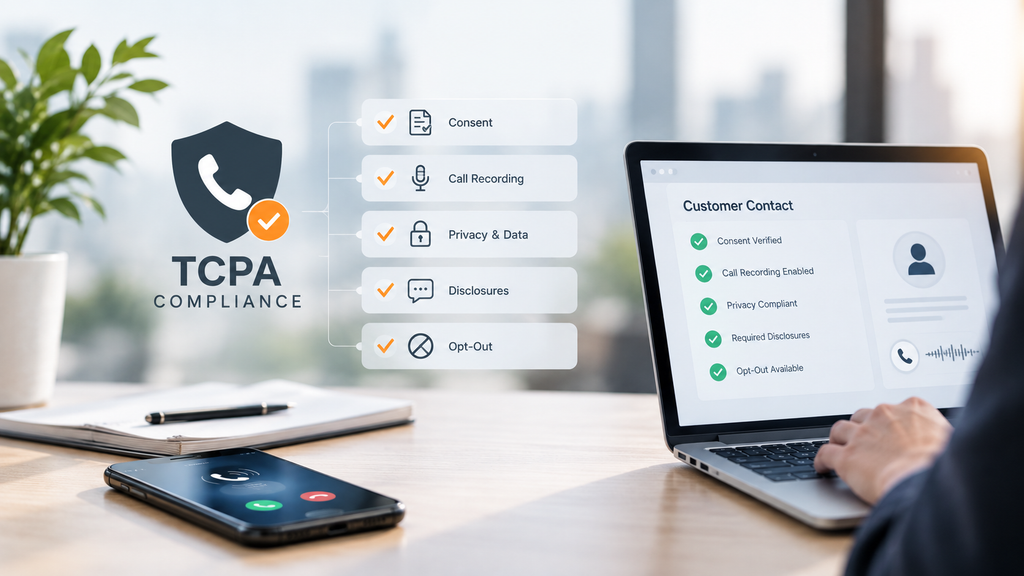
A lead can be valuable because someone has shown interest in a product or service. But getting that lead does not automatically give a business unlimited permission to call or text the person.
That is why TCPA lead follow up needs to be treated as part of the customer-contact process—not as a simple sales automation task.
For businesses that respond to leads by phone or text, TCPA compliance can affect how consent is collected, how outreach is initiated, how opt-outs are handled, what records are retained, and how responsibilities are divided between brands, lead generators, contact centers, agencies, and technology providers.
The key principle is straightforward:
A lead record is not the same thing as a documented right to make every type of follow-up communication.
The specific requirements depend on the communication, technology, recipient, consent, and applicable law. This guide explains the operational issues businesses should consider when building a TCPA-aware lead follow-up process.
Important: This article is for general informational purposes and is not legal advice. TCPA, FTC, and state requirements can vary by campaign and circumstance. Have qualified counsel review your specific lead-generation and customer-contact workflows before relying on them.
What Does TCPA Lead Follow-Up Mean?
TCPA lead follow-up refers to the calls, texts, and other covered telephone communications a business makes after a consumer becomes a lead.
A lead might enter a business through:
- A website form
- A quote request
- A comparison site
- A paid advertisement
- A call-focused campaign
- A publisher or affiliate
- A referral
- A landing page
- A CRM import
- An inbound call followed by additional outreach
The business may then want to call the consumer, send a text, leave a prerecorded message, or use automated technology to continue the conversation.
The compliance question is not simply whether the person became a lead.
It is whether the business has an appropriate basis to make the particular communication using the particular technology involved.
That distinction becomes especially important when a lead is passed between multiple companies.
TCPA Compliance Starts With Knowing What Kind of Contact You Are Making
There is no single compliance rule that applies identically to every telephone interaction.
Businesses should first identify what they are actually doing.
For example:
Live human call: A representative manually contacts a lead.
Automated or prerecorded call: Technology initiates a call or delivers an artificial or prerecorded voice message.
Text message: A business sends an SMS or similar message to the consumer.
Telemarketing: The communication encourages the purchase or rental of goods or services.
Informational communication: The purpose may be transactional or informational rather than promotional.
The applicable requirements can differ between these scenarios.
The FCC’s rules distinguish prior express consent from prior express written consent, with the written-consent standard applying to covered telemarketing or advertising calls using an automatic telephone dialing system or artificial/prerecorded voice. The current federal rules should be checked directly before launching or changing a campaign.
That means a company should not create one generic “TCPA consent” field and assume it answers every compliance question.
What Should a Lead Follow-Up System Record?
A strong compliance process starts before the first follow-up call.
When a lead enters the system, capture the information needed to understand how the contact was generated and what consent was provided.
Depending on the workflow, that can include:
- Consumer name
- Phone number
- Lead source
- Campaign
- Landing page
- Date and time of submission
- Consent language presented
- Version of the consent language
- Method used to provide consent
- Relevant disclosure
- Communication channel
- Requested product or service
- Lead-provider information
- Routing history
- Subsequent opt-out requests
- Contact attempts
- Final outcome
The objective is not to collect data for its own sake.
The objective is to be able to reconstruct the customer-contact journey.
If a consumer becomes a lead through a publisher, for example, the receiving business should be able to determine where the lead originated and what information was presented when the consumer submitted the inquiry.
The FTC’s updated Telemarketing Sales Rule recordkeeping requirements also make documentation increasingly important for businesses covered by that rule. The FTC says covered sellers and telemarketers must retain records concerning consent and telemarketing activity, with certain records retained for five years.
Consent Should Be Captured in Context
One of the most common operational mistakes is treating consent as a yes-or-no field without preserving the context around it.
Imagine a lead form containing a checkbox that says a consumer agrees to be contacted.
The database may record:
Consent = Yes
That alone may not tell the business:
- What exactly the consumer agreed to
- Who was identified as the caller
- Whether the communication was a call, text, or both
- Whether automated technology was disclosed
- What language appeared next to the checkbox
- Which version of the form was displayed
- When consent was provided
- Which phone number the consent related to
For that reason, businesses should design consent capture around evidence rather than a simple database status.
The FTC’s updated telemarketing recordkeeping rules specifically address records of consent and require businesses to retain records showing how consent was obtained. For website-based consent, the FTC has explained that preserving a copy of the consent request and the consumer’s consent can be important.
Lead Generation Does Not End the Compliance Responsibility
A lead generator, publisher, agency, network, or comparison site may be responsible for generating the opportunity.
That does not mean the receiving business should assume that every compliance responsibility has been transferred to the lead source.
The parties should clearly define:
- Who collects consent
- What consent language is used
- Which entity is identified
- Which communication channels are covered
- How consent evidence is stored
- Who handles opt-outs
- How Do Not Call requirements are managed
- How records are transferred
- How complaints are escalated
- Who is responsible for vendor oversight
The FTC’s telemarketing guidance specifically addresses situations involving sellers and telemarketers working together and makes clear that contractual relationships do not eliminate applicable obligations.
This is particularly relevant to lead marketplaces and pay-per-call programs, where several companies may participate in generating, selling, routing, or handling an opportunity.
Do Not Call Is a Separate Operational Layer
Consent management and Do Not Call management should not be treated as the same thing.
Businesses subject to the FTC’s Telemarketing Sales Rule generally need to access the National Do Not Call Registry and update their calling lists at least every 31 days. The FTC also expects businesses to maintain entity-specific Do Not Call procedures and records.
A practical workflow should therefore include:
Lead arrives → Consent evaluated → DNC status checked → Outreach permitted or blocked → Contact made → Opt-out captured → Suppression updated
This should happen consistently across systems.
A common failure point is the gap between a consumer’s opt-out request and the systems used by different teams or vendors.
If the consumer asks one representative not to call again but that request does not reach the CRM, dialer, contact center, or marketing platform, the business can create a repeat-contact problem.
Opt-Out Requests Need to Reach the Workflow
A consumer’s request not to receive further communications should not live only inside an individual employee’s notes.
It should enter the organization’s suppression process.
For example:
Consumer: “Please don’t text me anymore.”
Representative: Records the request.
CRM: Updates the contact’s communication status.
Messaging platform: Suppresses future messages.
Call platform: Applies the appropriate calling restriction.
Vendor or partner: Receives the relevant suppression information when applicable.
The FCC’s rules provide specific mechanisms for revoking consent for covered calls and texts, including certain words and automated mechanisms as reasonable means of revocation, with current rules also addressing the time within which revocation requests must be honored.
Because the details matter, businesses should have counsel review their actual opt-out implementation rather than relying on a generic “unsubscribe” process.
Lead Follow-Up Timing Does Not Override Compliance
Speed-to-lead matters.
A business may want to contact a new lead immediately because customer interest can decline over time.
But urgency does not replace the need for an appropriate legal basis for the communication.
A useful operational model is:
Fast response + correct consent + correct channel + correct recipient + correct documentation
not:
Fast response at any cost
This is particularly important when automated systems are involved.
A CRM can trigger a call or text seconds after a form submission. That is operationally efficient, but automation can also scale an incorrect assumption just as quickly as a correct one.
Compliance should therefore be built into the workflow before the automation is activated.
What About AI Voice and Automated Customer Contact?
AI adds another layer to the TCPA discussion.
In 2024, the FCC confirmed that the TCPA’s restrictions on artificial or prerecorded voices encompass current AI technologies that resemble human voices or generate call content using a prerecorded voice. The FCC stated that callers must obtain prior express consent before making calls using covered artificial or prerecorded voice technology, subject to applicable rules and exceptions.
That means businesses should not assume that calling a lead through an AI voice system is equivalent to having a human representative make the call manually.
Before deploying AI voice follow-up, organizations should determine:
- What technology is actually being used
- Whether the communication uses an artificial or prerecorded voice
- What consent applies
- What disclosures are required
- How opt-outs work
- How human escalation works
- How call records are retained
- Which vendor is responsible for which controls
AI can improve response operations, routing, analysis, and agent assistance.
It should not be treated as a compliance shortcut.
The 2025 One-to-One Consent Change Matters
Lead-generation businesses should also be careful when reading older TCPA compliance content.
The FCC adopted a 2023 rule that would have imposed additional restrictions on prior express written consent for certain telemarketing and advertising robocalls, including one-to-one consent and a logical-and-topical-association requirement.
In January 2025, the U.S. Court of Appeals for the Eleventh Circuit vacated those portions of the FCC’s rule, concluding that the additional restrictions exceeded the FCC’s statutory authority. The FCC subsequently updated its rules in 2025 to conform to the court decision.
This does not mean that consent requirements disappeared.
It means that businesses should not copy a pre-2025 explanation of the one-to-one rule into a current compliance policy without checking the present legal framework.
This is a good example of why compliance articles, internal procedures, consent language, and technology configurations need periodic legal review.
What Lead Buyers and Publishers Should Ask Each Other
Compliance should be part of the commercial relationship between lead sources and buyers.
A buyer evaluating a lead source can ask:
- Where is the lead generated?
- What consent language is displayed?
- What communication channels does the consent address?
- How is consent recorded?
- Can the buyer receive the relevant evidence?
- How are opt-outs handled?
- How are duplicate or recycled leads managed?
- What vendors participate in the process?
- How are complaints escalated?
- What happens when compliance requirements change?
Publishers and lead generators should be prepared to answer these questions with documentation rather than general assurances.
That creates a more useful relationship between acquisition and customer-contact teams.
Compliance Should Be Connected to Lead Routing
Routing is not only a performance decision.
It can also be part of the compliance workflow.
For example, a lead may need to be routed differently depending on:
- Communication consent
- Geography
- Product
- Customer status
- Lead source
- Contact restrictions
- Agent availability
- Communication channel
The routing system should not simply ask:
“Who can handle this lead?”
It may also need to ask:
“Who can handle this lead through an allowed communication path?”
That distinction becomes increasingly important as businesses combine CRM systems, call routing, SMS platforms, contact centers, AI tools, and third-party lead sources.
Call Tracking Can Help Create an Audit Trail
Call tracking is primarily a measurement function, but the data it produces can also help organizations understand what happened during customer contact.
A useful record can connect:
Lead source → Consent record → Contact attempt → Call or text → Routing → Conversation → Outcome
This makes it easier to investigate questions such as:
- Which source generated the contact?
- When did the follow-up occur?
- Which team handled it?
- Was the consumer contacted by phone or text?
- Was an opt-out recorded?
- What happened afterward?
Contact.io’s existing coverage of call tracking and attribution explains how call-level information can connect acquisition sources with downstream outcomes. The same operational visibility can be valuable when investigating customer-contact workflows.
Build a TCPA-Aware Lead Follow-Up Workflow
A practical process can be organized into eight steps.
1. Capture the lead
Record the source, timestamp, contact information, campaign, and relevant submission data.
2. Preserve consent evidence
Store the consent language, method, timestamp, and other information necessary to understand what the consumer agreed to.
3. Determine the communication type
Identify whether the planned follow-up is a live call, automated call, text, prerecorded communication, AI-generated voice interaction, or another channel.
4. Apply the appropriate restrictions
Evaluate consent, Do Not Call status, internal suppression lists, and other applicable requirements.
5. Route the lead
Send the opportunity to the appropriate team, buyer, representative, or contact center.
6. Make contact
Use the approved communication method and follow the organization’s compliance procedures.
7. Process opt-outs immediately
Make sure requests reach the systems and vendors responsible for future contact.
8. Record the outcome
Capture whether the lead was contacted, qualified, converted, disqualified, opted out, or otherwise moved to another status.
This workflow connects compliance with the same operational systems that drive lead conversion.
What Should Businesses Audit?
A periodic compliance audit can examine the complete journey rather than reviewing only the consent checkbox.
Questions might include:
Lead acquisition
- Where did the lead come from?
- What was shown to the consumer?
Consent
- What did the consumer agree to?
- Can the business reproduce the consent record?
Contact
- What communication was made?
- Which technology was used?
Suppression
- Was the contact subject to a Do Not Call or internal suppression restriction?
- Were opt-outs propagated correctly?
Vendors
- Which companies touched the lead?
- Are responsibilities documented?
Records
- Are required records being retained?
- Can the organization reconstruct the communication history?
Outcomes
- What happened after contact?
- Are complaints or compliance failures being tracked?
This approach makes compliance part of operational quality assurance rather than an annual paperwork exercise.
The Revenue Connection
Compliance is sometimes treated as a cost center because it can introduce additional controls, review steps, and documentation.
But customer-contact compliance also protects the value of the lead pipeline.
A lead that cannot be contacted appropriately has limited commercial value.
A campaign that generates complaints can create operational and reputational costs.
A lead source that cannot demonstrate reliable consent records can create uncertainty for the buyer.
A contact center that does not process suppression requests consistently can create repeated-contact problems.
In other words, compliance and conversion are not completely separate.
The objective is to create a customer-contact process that is both commercially effective and appropriately controlled.
For businesses that depend on calls and lead follow-up, the more useful framework is:
Qualified lead → Appropriate consent → Permitted contact → Productive conversation → Customer → Revenue
Compliance belongs inside that workflow.
How Contact.io Connects Lead Follow-Up and Compliance
Contact.io focuses on the part of customer acquisition that begins after consumer interest is generated.
Its current Lead Conversion Conference programming includes lead response, call tracking and attribution, intelligent routing, contact-center performance, AI-powered customer contact, lead quality, fraud prevention, compliance, and consumer trust.
That combination matters because lead follow-up is not an isolated marketing function.
A lead needs to be captured correctly.
It needs to reach the right destination.
The business needs to know whether it can contact the consumer and through which channel.
The interaction needs to be handled effectively.
The outcome needs to be measured.
And the process needs to respect applicable consent and consumer-contact requirements.
Contact.io brings together brands, lead buyers, publishers, agencies, contact centers, technology providers, and compliance professionals working across these connected areas.
Frequently Asked Questions
Does getting a lead give a business permission to call the person?
Not automatically. The applicable legal basis depends on the type of communication, technology, recipient, consent, and other circumstances. Businesses should not treat the existence of a lead record as blanket permission for every form of follow-up.
Does TCPA apply to lead follow-up texts?
TCPA requirements can apply to covered text messages, including certain automated or marketing messages. The exact requirements depend on the message, technology, consent, recipient, and applicable rules. Businesses should have counsel review their SMS workflow.
How should businesses document TCPA consent?
A useful consent record can include the lead source, date and time, phone number, consent language, form or page version, method of consent, and other evidence needed to reconstruct what the consumer saw and agreed to.
Is one-to-one consent currently required under the FCC’s 2023 rule?
The FCC’s 2023 one-to-one and logical-and-topical consent restrictions were vacated by the Eleventh Circuit in January 2025, and the FCC subsequently updated its rules to conform to that decision. Businesses should not rely on older summaries of that rule without checking the current legal framework.
Does TCPA apply to AI voice calls?
The FCC confirmed in 2024 that the TCPA’s restrictions on artificial or prerecorded voices encompass current AI technologies that resemble human voices or generate call content using a prerecorded voice. The requirements depend on the specific call and applicable rules.
How often should businesses review their lead follow-up compliance process?
Compliance should be reviewed whenever the business changes its lead sources, consent language, communication channels, automation, vendors, routing, or AI technology, as well as when relevant federal or state requirements change. Legal review should be part of that process.
TCPA Compliance Should Be Part of the Lead Process
Lead follow-up is often measured by speed and conversion.
Those metrics matter, but they do not tell the entire story.
A reliable customer-contact process also needs to answer:
Why can we contact this person?
How can we contact them?
What evidence supports that decision?
What happens if the consumer asks us to stop?
Which vendors and systems need to know?
When those questions are built into the workflow, compliance becomes part of the same operating system that manages lead response, routing, contact-center performance, and conversion.
For businesses that turn leads and inbound calls into revenue, that is the practical goal: respond quickly, create productive conversations, measure the outcome, and build customer-contact processes that respect applicable requirements along the way.