
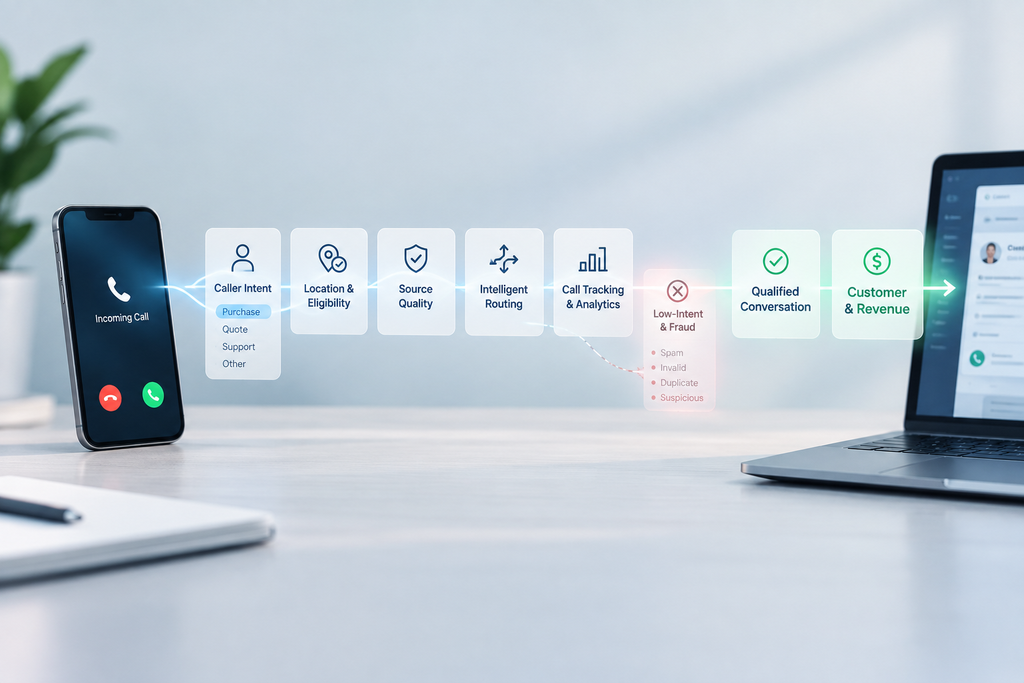
Pay-per-call marketing can generate highly valuable customer conversations, but call volume alone does not determine whether a campaign is performing well.
A program can generate hundreds or thousands of inbound calls while still producing relatively few qualified opportunities. Some callers may be outside the target geography, looking for a different product, existing customers rather than new prospects, or simply not ready to take action. Others may come from low-intent or potentially fraudulent traffic.
That is why pay-per-call lead quality matters.
Improving lead quality means creating a clearer connection between the calls being generated and the customers a business actually wants to acquire. That requires more than changing a traffic source. Buyers and publishers need shared qualification criteria, reliable tracking, appropriate routing, useful feedback, and a measurement framework that connects call quality to downstream customer and revenue outcomes.
This guide explains how brands, call buyers, publishers, agencies, and call-driven businesses can improve the quality of inbound calls and build a more reliable path from call to customer.
What Is Pay-Per-Call Lead Quality?
Pay-per-call lead quality refers to how closely an inbound call matches the buyer’s requirements and how likely that conversation is to create a meaningful business outcome.
A high-quality call may have characteristics such as:
- The caller is in an eligible geographic market.
- The caller is interested in the advertised product or service.
- The caller meets the campaign’s customer criteria.
- The caller has genuine purchase or service intent.
- The call reaches the appropriate destination.
- The conversation creates a legitimate opportunity.
- The interaction can be measured and attributed.
- The caller has not already been excluded by the campaign rules.
The exact definition varies by business.
An insurance buyer, home-services company, mortgage provider, and education company may all have completely different definitions of a qualified call.
The important point is that quality needs to be defined before it can be measured and improved.
For a broader look at the ecosystem, see the Contact.io Pay-Per-Call Conference, which focuses on the businesses and professionals involved in generating, buying, selling, routing, managing, and converting inbound calls.
Why Pay-Per-Call Lead Quality Matters
The goal of pay-per-call marketing is not simply to generate phone calls.
The goal is to generate valuable customer conversations.
Consider two traffic sources.
Source A generates 1,000 calls, but only 100 meet the buyer’s qualification criteria.
Source B generates 400 calls, but 240 are qualified.
If the buyer evaluates the sources only by call volume, Source A appears stronger.
If the buyer evaluates qualified conversations, the picture is different.
This is why pay-per-call marketers should look beyond metrics such as:
- Total calls
- Cost per call
- Call duration
- Connection volume
and examine metrics such as:
- Qualified-call rate
- Conversion rate
- Revenue per call
- Customer acquisition cost
- Revenue by source
- Customer value
- Downstream outcomes
Contact.io’s current pay-per-call programming emphasizes this broader ecosystem, including call quality, tracking, attribution, routing, fraud prevention, contact-center performance, and conversion.
1. Define What a Qualified Call Means
The first step toward improving pay-per-call lead quality is creating a clear definition of a qualified call.
“Good call” is too vague.
Instead, establish measurable criteria.
Depending on the business, qualification might include:
- Geographic eligibility
- Product or service interest
- Customer type
- Age or other eligibility requirements
- New versus existing customer
- Purchase intent
- Call timing
- Call duration
- Appointment intent
- Service availability
- Caller need
- Campaign-specific requirements
For example, a buyer might define a qualified call as:
A new customer in an eligible geographic area who is actively seeking the advertised service and meets the campaign’s agreed qualification requirements.
The exact criteria should reflect the buyer’s business model.
The goal is not to create the most complicated definition possible.
The goal is to create a definition that buyers, publishers, networks, and internal teams can understand consistently.
2. Separate Call Volume From Call Quality
Call volume is useful, but it should not be treated as a complete measure of performance.
A source producing 5,000 calls may look impressive until the buyer discovers that most callers are outside the service area or have little interest in the advertised product.
A smaller source may produce fewer calls while generating a much higher percentage of qualified conversations.
A useful reporting structure is:
Calls generated → Calls connected → Qualified calls → Opportunities → Customers → Revenue
Each stage answers a different question.
Calls generated
How much demand did the source produce?
Calls connected
How many calls actually reached the buyer or intended destination?
Qualified calls
How many calls met the agreed requirements?
Opportunities
How many calls created a legitimate commercial opportunity?
Customers
How many calls ultimately produced customers?
Revenue
How much measurable business resulted?
This structure prevents the organization from confusing activity with value.
3. Evaluate Traffic Sources at the Source Level
Overall campaign performance can hide major differences between individual sources.
A pay-per-call program may include:
- Multiple publishers
- Affiliate partners
- Paid-search campaigns
- Advertising channels
- Networks
- Landing pages
- Geographic campaigns
- Different creative approaches
- Different keywords
- Different audience segments
If every source is evaluated together, poor-performing traffic can be hidden by stronger sources.
Source-level analysis can reveal:
- Which publishers generate qualified calls
- Which campaigns generate customers
- Which traffic sources create high-value conversations
- Which sources generate unusually high rejection rates
- Which campaigns produce low-intent callers
- Which sources generate strong revenue after the call
- Where quality changes over time
This makes optimization much more precise.
Instead of asking:
“Are our pay-per-call campaigns working?”
the team can ask:
“Which sources are consistently producing the customers we want?”
For more context on the difference between acquisition infrastructure and measurement infrastructure, see Pay-Per-Call Networks vs. Call Tracking Platforms.
4. Look Beyond Call Duration
Call duration can sometimes provide useful information about call quality, but it should not be treated as a universal definition of a qualified call.
A long call is not automatically a good call.
A short call is not automatically a bad call.
For example, a highly qualified caller might receive a quick answer, get exactly what they need, and convert efficiently.
Another caller might remain on the phone for a long time without ever becoming a customer.
Duration can therefore be one signal among several.
Consider combining it with:
- Qualification status
- Call outcome
- Caller intent
- Product fit
- Geographic eligibility
- Appointment status
- Conversion
- Revenue
This produces a much more useful picture of quality.
5. Measure Caller Intent
Intent is one of the most important dimensions of pay-per-call lead quality.
Two callers can use the same phone number while having completely different reasons for calling.
One may be ready to purchase.
Another may simply be looking for general information.
Another may be calling about an existing account.
Another may have misunderstood the advertisement.
Understanding intent helps businesses distinguish between different types of conversations.
Depending on the business and technology available, intent can be evaluated through:
- Pre-call information
- Campaign and keyword data
- Landing-page context
- Call reason
- Conversation analysis
- Agent qualification
- Post-call outcomes
- Customer actions
AI-powered conversation analytics can also potentially help organizations identify patterns in caller intent, although automated classifications should be treated as signals that may require validation rather than unquestionable decisions.
For a deeper look at how AI can support intent detection, routing, conversation analysis, and other parts of the pay-per-call process, see How AI Is Changing Pay-Per-Call Marketing.
6. Match the Traffic to the Product
Lead quality is partly a matter of product-market fit.
If the traffic source attracts consumers who do not actually need the advertised product, the buyer may receive a large number of calls that cannot realistically convert.
This can happen when:
- Advertising is too broad.
- Creative creates the wrong expectation.
- Keywords attract informational rather than commercial searches.
- Landing pages are unclear.
- Offers do not match the actual product.
- Publishers promote the wrong service.
- Geographic targeting is too broad.
The solution is not necessarily to reduce traffic.
It may be to improve the alignment between the traffic source and the offer.
The buyer should ask:
Who is this campaign designed to attract?
Then:
Does the traffic actually match that customer profile?
That connection is fundamental to lead quality.
7. Create Clear Buyer-Publisher Qualification Rules
Pay-per-call works across an ecosystem of buyers, publishers, agencies, networks, and technology providers.
That means quality expectations need to be communicated between the parties.
Before scaling a campaign, buyers and publishers should understand:
- What counts as a qualified call
- Which geographic areas are eligible
- Which customer types are accepted
- Which products or services are included
- Whether existing customers qualify
- How calls are tracked
- How rejected calls are identified
- How disputes are handled
- Which outcomes are reported
- What compliance responsibilities apply
Clear rules reduce ambiguity.
They also create a stronger foundation for optimization.
If a publisher knows exactly what the buyer considers valuable, it becomes easier to identify which traffic sources, campaigns, audiences, and messages are producing the desired outcome.
8. Use Call Tracking to Find Quality Differences
Call tracking provides the data needed to understand what happens to inbound calls.
Tracking can help connect calls with information such as:
- Source
- Campaign
- Publisher
- Keyword
- Landing page
- Geographic location
- Time
- Call duration
- Destination
- Connection status
- Call outcome
That information becomes more valuable when connected with downstream conversion and revenue data.
For example:
Publisher A → 1,000 calls → 400 qualified → 80 customers
versus:
Publisher B → 600 calls → 360 qualified → 110 customers
Without tracking and attribution, both publishers may simply appear to be sources of calls.
With better measurement, the buyer can begin to understand differences in quality and commercial value.
For a deeper explanation of the measurement layer, see Call Tracking and Attribution for Pay-Per-Call Campaigns.
9. Improve Call Routing
Even a high-quality call can lose value if it is routed incorrectly.
Imagine a caller with strong purchase intent reaching:
- The wrong department
- An unavailable agent
- A general queue
- A representative without the required expertise
- An overloaded contact center
The problem in that situation may not be the traffic source.
It may be the routing process.
Intelligent routing can use information such as:
- Caller location
- Product interest
- Customer type
- Intent
- Agent availability
- Agent specialization
- Business hours
- Language
- Call value
- Existing customer status
The objective is to connect the right caller with the right destination as efficiently as possible.
Contact.io’s current pay-per-call programming specifically includes intelligent call routing alongside call tracking, attribution, lead quality, contact-center performance, and conversion.
10. Monitor What Happens After the Call
A call should not disappear from the measurement system once it ends.
To understand quality, businesses should connect call-level information with downstream outcomes wherever possible.
That may include:
Call → Qualification → Appointment → Sale → Revenue
This helps answer questions such as:
- Which sources generate appointments?
- Which publishers produce customers?
- Which campaigns generate revenue?
- Which call types rarely convert?
- Which buyer destinations perform best?
- Which customer segments produce the highest value?
This is especially important because the definition of a “good call” ultimately depends on the business outcome.
A call can satisfy an initial qualification rule and still fail to produce a valuable customer.
That does not necessarily mean the call was bad. It may reveal a later-stage issue involving sales execution, pricing, follow-up, routing, product fit, or another part of the customer journey.
For a broader framework connecting acquisition, qualification, customer outcomes, and revenue, see How to Build a Lead-to-Revenue Funnel That Finds Conversion Gaps.
11. Identify Low-Intent Traffic
Not every low-quality call is fraudulent.
Some calls are simply low intent.
Examples might include callers who:
- Are only researching
- Want a service the company does not provide
- Misunderstood the advertisement
- Are outside the target geography
- Are existing customers contacting the wrong department
- Are looking for a different product
- Are not ready to take the desired action
These calls can still consume marketing and contact-center resources.
Identifying patterns can help buyers and publishers determine whether the problem comes from:
- Targeting
- Messaging
- Creative
- Landing pages
- Keywords
- Offer design
- Publisher behavior
- Qualification rules
The goal should be to identify the source of the problem rather than simply labeling every unwanted call as fraud.
12. Watch for Potentially Fraudulent Activity
Pay-per-call programs can also encounter suspicious traffic.
Potential warning signals can include:
- Unusual call-volume spikes
- Repeated caller patterns
- Large numbers of very short calls
- Suspicious geographic activity
- Duplicate or repeated interactions
- Traffic patterns inconsistent with the campaign
- Unusual activity concentrated around a specific source
- Call behavior that does not match expected customer activity
However, an individual signal does not automatically prove fraud.
A short call, unusual location, or unexpected spike may have a legitimate explanation.
Fraud detection should therefore use multiple signals and appropriate investigation.
This distinction matters because incorrectly rejecting legitimate calls can damage relationships with publishers and reduce access to valuable traffic.
Contact.io currently identifies both call fraud and low-intent traffic as distinct lead-quality challenges within its pay-per-call programming.
13. Give Publishers Useful Feedback
Quality improvement should not be a one-way process.
If a publisher receives only a simple message saying that its calls are “bad,” it has very little information to use for optimization.
More useful feedback might show:
- Qualification rate
- Geographic rejection rate
- Product mismatch
- Appointment rate
- Customer conversion
- Revenue contribution
- Common caller objections
- Call outcome patterns
The amount of information shared will depend on commercial relationships, privacy considerations, and the organization’s reporting capabilities.
But the principle is straightforward:
Better feedback creates better opportunities for optimization.
Publishers can use that information to adjust targeting, creative, campaigns, traffic sources, and other acquisition variables.
Buyers can use the resulting improvements to identify stronger partners.
14. Improve the Offer and Advertising Message
Sometimes lead quality problems begin before the consumer ever calls.
If an advertisement promises something that the business does not actually provide, the resulting calls may be poorly matched from the beginning.
Review:
- Headlines
- Ad copy
- Calls to action
- Landing pages
- Offers
- Disclosures
- Eligibility language
- Geographic messaging
- Product descriptions
Ask whether a reasonable consumer would understand what they are being invited to call about.
The closer the advertisement matches the actual customer experience, the more likely the resulting conversations are to be relevant.
15. Improve Qualification Without Creating Too Much Friction
Qualification is useful, but excessive qualification can create its own problems.
If the buyer requires too many steps before a consumer can connect, some legitimate prospects may abandon the process.
The objective should be to identify the information that genuinely matters.
For example, depending on the business, the most useful qualification signals may be:
- Location
- Product need
- Customer status
- Service eligibility
- Purchase intent
A qualification process should help the business prioritize opportunities without unnecessarily preventing legitimate customers from reaching the right person.
16. Use AI Carefully to Analyze Call Quality
AI is increasingly being used in pay-per-call and contact-center environments for:
- Intent detection
- Conversation analytics
- Call classification
- Automated quality assurance
- Agent assistance
- Call summaries
- Lead scoring
- Routing recommendations
- Pattern detection
These applications can potentially help organizations analyze a larger volume of conversations than manual review alone.
For example, AI could identify calls containing signals associated with:
- Strong purchase intent
- Product questions
- Repeated objections
- Qualification issues
- Transfer problems
- Potential compliance concerns
- Poor customer experiences
However, AI output should be treated as a tool for analysis and decision support, not as unquestionable evidence.
See How AI Is Changing Pay-Per-Call Marketing for a broader discussion of AI applications across caller intent, routing, agent assistance, analytics, fraud detection, and attribution.
17. Build a Pay-Per-Call Lead Quality Scorecard
A scorecard can make quality easier to monitor consistently.
A buyer might track:
| Metric | What It Tells You |
|---|---|
| Call volume | How much demand a source generates |
| Connection rate | How many calls reach the intended destination |
| Qualified-call rate | How closely calls match campaign requirements |
| Conversion rate | How often calls produce the defined conversion |
| Customer rate | How often calls result in customers |
| Revenue per call | Commercial value generated by calls |
| Cost per qualified call | Cost of acquiring qualified conversations |
| Customer acquisition cost | Cost of acquiring customers |
| Rejection rate | How often calls fail qualification |
| Transfer rate | How frequently calls require additional routing |
| Abandonment rate | How often callers leave before meaningful contact |
| Source-level revenue | Which sources produce downstream value |
The exact scorecard should match the business model.
There is no universal set of metrics that works for every pay-per-call campaign.
18. Compare Sources Using Business Outcomes
Once the scorecard is established, compare sources using the metrics that actually matter.
For example:
Source A
- High call volume
- Moderate qualification
- Low customer conversion
- Low revenue per call
Source B
- Lower call volume
- High qualification
- Strong customer conversion
- Higher revenue per call
The second source may deserve closer attention even though it produces fewer calls.
The purpose of source comparison is not to reward volume.
It is to understand which sources contribute to the business objective.
19. Review Quality Trends Over Time
Lead quality is not static.
A source that performs well today may perform differently next month.
Changes can occur because of:
- New advertising campaigns
- Seasonal demand
- New publishers
- Different targeting
- Offer changes
- Market conditions
- Routing changes
- Contact-center staffing
- Product changes
- Traffic mix
- Consumer behavior
That means quality should be monitored continuously rather than evaluated only when a campaign launches.
Look for changes in:
- Qualification rate
- Call volume
- Conversion
- Revenue
- Geographic distribution
- Caller intent
- Rejection reasons
- Publisher-level performance
Trend analysis can reveal problems before they become major performance issues.
20. Connect Lead Quality to Revenue
Ultimately, the most useful question is not:
“How many good calls did we receive?”
It is:
“How much business did those calls create?”
A useful progression is:
Traffic source → Calls → Qualified calls → Opportunities → Customers → Revenue
This connects marketing activity with the business outcome.
For example, a buyer may discover that one publisher produces:
- 30% fewer calls
- 20% more qualified conversations
- 15% more customers
- Higher revenue per customer
That information changes how the buyer should evaluate the source.
The objective is not necessarily to maximize any single metric.
It is to understand the economics of the entire customer-acquisition process.
Common Pay-Per-Call Lead Quality Mistakes
Several mistakes appear repeatedly in call-driven acquisition programs.
Optimizing for call volume
More calls do not automatically mean more customers.
Using vague qualification criteria
If nobody agrees on what makes a call qualified, reporting becomes difficult.
Evaluating all sources together
Aggregated reporting can hide significant differences between publishers and campaigns.
Relying on call duration alone
Duration is a useful signal in some contexts, but it does not define quality by itself.
Ignoring routing
A qualified caller can still be lost through poor routing or contact-center execution.
Measuring only the first interaction
The call may need to be connected to an appointment, sale, or other downstream outcome.
Treating every bad call as fraud
Low intent, poor targeting, product mismatch, and fraud are different problems.
Failing to provide feedback
Publishers cannot optimize effectively if they do not understand which calls are valuable.
Treating AI as a complete solution
Technology can improve analysis and execution, but it cannot replace clear business objectives and operating processes.
A Practical Framework for Improving Pay-Per-Call Lead Quality
Businesses can use the following process to systematically improve call quality.
Step 1: Define the ideal customer
Identify the customer profile the campaign is designed to attract.
Step 2: Define the qualified call
Create specific qualification criteria.
Step 3: Measure every meaningful stage
Track calls, connections, qualification, opportunities, customers, and revenue.
Step 4: Analyze sources separately
Compare publishers, campaigns, channels, and other acquisition sources.
Step 5: Identify rejection patterns
Determine why calls fail qualification.
Step 6: Fix the upstream problem
If calls are geographically wrong, improve targeting.
If callers misunderstand the offer, improve messaging.
If traffic is relevant but poorly routed, improve routing.
If qualified calls are not converting, examine the contact-center or sales process.
Step 7: Improve feedback loops
Share appropriate performance information with acquisition partners.
Step 8: Monitor downstream outcomes
Connect call quality to appointments, customers, revenue, and other meaningful outcomes.
Step 9: Test improvements
Change one or more controllable variables and measure the result.
Step 10: Repeat
Lead-quality optimization is an ongoing process rather than a one-time project.
Pay-Per-Call Lead Quality and the Broader Customer Journey
Lead quality cannot always be isolated from the rest of the customer-acquisition system.
The journey may look like:
Demand Generation → Call Acquisition → Tracking → Qualification → Routing → Conversation → Conversion → Revenue
A problem at any stage can affect the final outcome.
A buyer may believe it has a traffic-quality problem when the actual issue is:
- Slow answer times
- Incorrect routing
- Poor qualification
- Weak sales execution
- Missing attribution
- Inadequate follow-up
- Insufficient contact-center capacity
This is why lead-quality analysis should consider the entire journey.
Contact.io’s broader lead-to-revenue funnel framework similarly emphasizes connecting acquisition, qualification, engagement, customer, and revenue stages rather than treating lead volume as the final outcome.
For businesses focused on the broader process of turning leads and inbound calls into customers, the Contact.io Lead Conversion Conference covers lead response, inbound call performance, routing, attribution, compliance, and AI-powered customer contact.
How Contact.io Fits Into the Pay-Per-Call Lead Quality Conversation
Pay-per-call lead quality sits at the intersection of marketing, technology, operations, and revenue.
Brands need to understand what makes a valuable call.
Publishers need to understand what buyers actually want.
Contact centers need to convert qualified conversations effectively.
Technology providers need to help organizations track, route, analyze, and improve those interactions.
That is why Contact.io brings together brands, call buyers, publishers, agencies, contact centers, and technology providers around topics including call quality, intelligent routing, attribution, fraud prevention, AI-powered customer contact, compliance, and conversion.
The current Contact.io Pay-Per-Call Conference is scheduled for August 23–24, 2027, at the Seminole Hard Rock Hotel & Casino Hollywood in Hollywood, Florida.
For businesses working to improve the connection between inbound calls and revenue, these topics are part of the same larger challenge: creating better conversations with the right customers.
FAQ: Improving Pay-Per-Call Lead Quality
What is pay-per-call lead quality?
Pay-per-call lead quality describes how closely inbound calls match a buyer’s target customer and campaign requirements and how effectively those calls can produce meaningful business outcomes.
How can I improve pay-per-call lead quality?
Start by defining what a qualified call means, then evaluate traffic sources, improve targeting and messaging, use reliable call tracking, optimize routing, monitor downstream conversion, and provide useful feedback to acquisition partners.
What makes a pay-per-call lead high quality?
A high-quality call generally comes from a relevant customer, matches the campaign’s eligibility requirements, demonstrates appropriate intent, reaches the correct destination, and has a reasonable opportunity to produce a meaningful business outcome.
Is call duration a good measure of lead quality?
Call duration can be a useful quality signal in some campaigns, but it should not be used by itself. Qualification, intent, conversion, customer outcomes, and revenue can provide additional context.
How do I measure pay-per-call lead quality?
Useful measurements can include qualified-call rate, connection rate, conversion rate, customer rate, rejection rate, revenue per call, customer acquisition cost, and source-level revenue.
How can call tracking improve pay-per-call lead quality?
Call tracking can connect inbound conversations with their marketing sources and provide data that helps buyers identify which campaigns, publishers, and channels generate valuable calls.
For more detail, see Call Tracking and Attribution for Pay-Per-Call Campaigns.
Can AI improve pay-per-call lead quality?
AI can potentially help identify caller intent, analyze conversations, classify calls, support routing, automate quality assurance, and identify patterns across large volumes of interactions. Human review and clear business rules remain important.
See How AI Is Changing Pay-Per-Call Marketing for more on these applications.
How can buyers and publishers work together to improve call quality?
They can establish clear qualification criteria, agree on measurement methods, share appropriate performance feedback, investigate disputed calls consistently, and use downstream outcomes to improve acquisition strategies.
Conclusion: Better Pay-Per-Call Quality Starts With Better Measurement
Improving pay-per-call lead quality is not simply about generating fewer bad calls.
It is about creating a more reliable system for identifying, routing, measuring, and converting the right customer conversations.
The process begins with clear qualification criteria.
From there, businesses can:
- Evaluate traffic sources
- Improve targeting
- Align advertising with the actual offer
- Track calls and attribution
- Improve routing
- Identify low-intent traffic
- Investigate potential fraud
- Provide useful publisher feedback
- Monitor downstream conversion
- Connect calls to customers and revenue
- Use AI where it can meaningfully support the process
The central idea is simple:
Do not optimize pay-per-call marketing for calls alone. Optimize it for valuable customer conversations and measurable business outcomes.
A high-quality pay-per-call program connects the entire journey:
Right source → Right caller → Right conversation → Right destination → Right outcome
That is where better lead quality becomes more than a marketing metric. It becomes part of a stronger customer-acquisition and revenue strategy.
For businesses operating across inbound calls, pay-per-call marketing, contact centers, lead conversion, tracking, routing, and customer-contact technology, Contact.io provides a focused environment for discussing how these pieces work together.
Where conversations turn into revenue.