
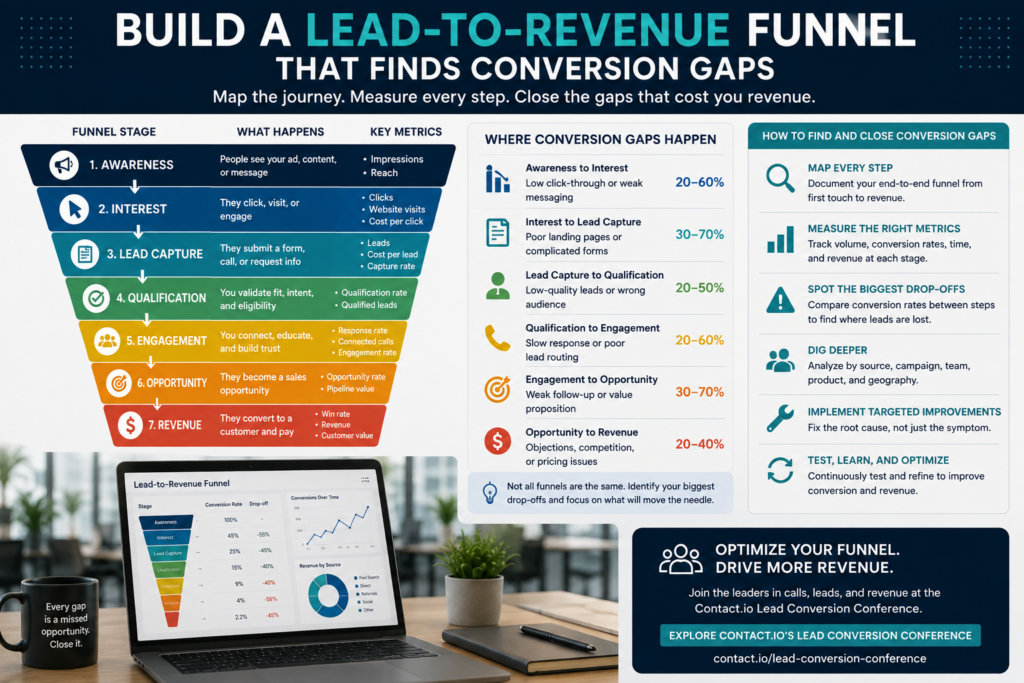
A lead-to-revenue funnel maps the complete journey from initial customer interest to qualified lead, opportunity, customer, and revenue. Unlike a basic lead funnel, it does not stop when a form is submitted or an opportunity is created. It connects every important stage so teams can see where prospects drop out, which sources produce customers, and which conversion gaps are costing revenue.
The basic concept is simple:
Lead source → Lead → Qualified lead → Engagement → Opportunity → Customer → Revenue
The value comes from measuring what happens between those points.
A business that generates 10,000 leads but cannot see which leads become customers has a volume report—not a revenue funnel.
What Is a Lead-to-Revenue Funnel?
A lead-to-revenue funnel is a framework for connecting lead acquisition and conversion activity to commercial outcomes.
Traditional marketing funnels often focus on moving people from awareness to interest and eventually to a lead. Sales funnels then take over.
A lead-to-revenue funnel connects those systems.
Salesforce describes lead-generation funnels using stages such as awareness, consideration, and decision, while distinguishing the lead funnel from the sales funnel. The lead-to-revenue approach extends that thinking by connecting the journey beyond lead capture to opportunities, customers, and revenue. Salesforce: Lead Generation Funnel
A practical lead-to-revenue funnel might look like:
Awareness → Interest → Lead Capture → Qualification → Engagement → Opportunity → Customer → Revenue
Not every business needs these exact stages. The right funnel reflects how customers actually move through the business.
For a call-driven organization, for example, the journey could be:
Marketing source → Inbound call → Connected conversation → Qualified call → Appointment → Sale → Revenue
The important principle is to map the real journey rather than forcing every business into the same template.
Why Build a Lead-to-Revenue Funnel?
Lead volume can be an important operating metric, but it does not tell you whether acquisition is creating business value.
Consider two campaigns:
Campaign A
- 5,000 leads
- 500 qualified leads
- 100 customers
- $200,000 revenue
Campaign B
- 2,000 leads
- 600 qualified leads
- 150 customers
- $350,000 revenue
Campaign A generated more than twice as many leads.
Campaign B generated more customers and more revenue.
If the business measured only lead volume, it could easily invest more heavily in the weaker campaign.
A lead-to-revenue funnel helps prevent that mistake by connecting acquisition activity to downstream outcomes.
It can answer questions such as:
- Which sources generate qualified leads?
- Which sources generate customers?
- Where are leads dropping out?
- How quickly are leads progressing?
- Which teams or channels convert best?
- How much revenue does each source generate?
- Where would an operational improvement have the greatest impact?
The 7 Core Stages of a Lead-to-Revenue Funnel
The exact structure should reflect your business, but seven stages provide a useful starting point.
1. Lead generation
This is where potential customers enter the funnel.
Sources may include:
- Organic search
- Paid advertising
- Social media
- Referrals
- Events
- Partnerships
- Website forms
- Click-to-call campaigns
- Inbound calls
- Pay-per-call campaigns
- Outbound prospecting
At this stage, measure both volume and source.
Useful metrics include:
- Leads generated
- Cost per lead
- Leads by source
- Leads by campaign
- Lead quality indicators
The objective is not simply to maximize volume. It is to understand which acquisition activities create opportunities worth pursuing.
2. Lead capture
The next stage is turning interest into an identifiable lead.
For digital channels, this might happen through a form, phone number, chat interaction, or other conversion mechanism.
For call-driven businesses, the inbound call itself may represent the lead event.
Capture the information necessary to understand the opportunity, including source, campaign, product or service interest, contact information, geography, and relevant qualification information.
The quality of this data affects every stage that follows.
3. Qualification
Qualification determines whether the lead matches the criteria for further attention.
Criteria vary by business but may include:
- Product or service fit
- Geography
- Eligibility
- Purchase intent
- Budget
- Timing
- Customer type
- Business size
- Need
- Decision-making authority
Qualification is important because not every lead has the same potential value.
A funnel should distinguish between someone who downloaded a piece of content and someone actively requesting a conversation about buying.
4. Engagement
Engagement is where the business begins meaningful interaction with the prospect.
This may involve:
- Phone calls
- SMS
- Messaging
- Meetings
- Demonstrations
- Live transfers
- Follow-up conversations
For phone-based organizations, the transition from lead to conversation can be particularly important.
Contact.io has written about the shift from simply measuring speed-to-lead toward measuring speed-to-conversation—the time required to move from initial interest to a meaningful interaction. Contact.io: Why Speed-to-Conversation Is Replacing Speed-to-Lead
The distinction matters because an attempted contact is not necessarily a productive engagement.
5. Opportunity
At this stage, the prospect has demonstrated enough fit and intent to enter the active sales process.
Depending on the business, an opportunity could be:
- A booked appointment
- A qualified sales opportunity
- A quote request
- A scheduled consultation
- A proposal
- A sales-qualified opportunity
Track both opportunity volume and the percentage of leads that reach this stage.
6. Customer
The opportunity becomes a customer when the defined commercial outcome occurs.
That might be:
- A completed purchase
- A signed contract
- A closed deal
- A booked service
- A new account
- A completed sale
This is the stage where many marketing reports stop—but the lead-to-revenue funnel should continue.
7. Revenue
Revenue connects customer acquisition back to actual business economics.
Depending on the business model, measure:
- Revenue per customer
- Revenue per lead
- Revenue per opportunity
- Revenue by source
- Revenue by campaign
- Customer value
- Gross margin where appropriate
This final layer changes the question from:
“How many leads did we generate?”
to:
“Which activities produced profitable customers?”
How to Find Conversion Gaps
A conversion gap is a point in the funnel where an unexpectedly large share of opportunities fails to progress.
The first step is to calculate conversion between every major stage.
For example:
10,000 leads
↓
6,000 contacted
↓
2,400 qualified
↓
1,200 opportunities
↓
300 customers
The overall lead-to-customer conversion rate is:
300 ÷ 10,000 × 100 = 3%
But that 3% does not tell you where the problem exists.
The stage-level rates tell a different story:
- Lead → Contacted: 60%
- Contacted → Qualified: 40%
- Qualified → Opportunity: 50%
- Opportunity → Customer: 25%
Now the organization has several places to investigate.
If only 60% of leads are contacted, response operations may be a problem.
If contact rates are strong but qualification is weak, lead quality or qualification criteria may need attention.
If opportunities are plentiful but few become customers, the issue may sit later in the sales process.
The biggest conversion gap is often more actionable than the lowest overall conversion rate.
Measure Drop-Off, Not Just Conversion
Conversion rate tells you how many opportunities progress.
Drop-off tells you how many do not.
For each stage, calculate:
Stage drop-off = 100% − stage conversion rate
For example, if 70% of leads are successfully contacted:
100% − 70% = 30% drop-off
This gives teams another way to prioritize improvement.
However, the largest percentage drop is not always the largest revenue opportunity.
Suppose:
- A small stage loses 50% of leads worth $10 each.
- A later stage loses 20% of opportunities worth $5,000 each.
The second gap may deserve more attention because its economic impact is larger.
That is why a revenue funnel should combine conversion metrics with business value.
Build a Funnel That Connects Marketing to Revenue
A useful lead-to-revenue funnel should preserve the original source of each opportunity.
At minimum, capture:
Source → Campaign → Lead → Qualification → Opportunity → Customer → Revenue
For example:
Paid search → Campaign A → 1,000 leads → 250 qualified → 80 opportunities → 20 customers → $100,000 revenue
Now marketing can see more than cost per lead.
It can see downstream performance.
This also creates a feedback loop.
If a campaign generates inexpensive leads but almost no qualified opportunities, the business can investigate targeting and lead quality.
If another campaign generates more expensive leads but significantly more customers, the higher acquisition cost may be justified.
The right comparison is therefore not simply:
Which source produces the cheapest leads?
It is:
Which source produces valuable customers at sustainable economics?
Segment Your Funnel
An overall funnel is useful for understanding the business.
Segmented funnels are useful for finding problems.
Break performance down by dimensions such as:
Lead source
Compare:
- Organic
- Paid search
- Paid social
- Referral
- Partner
- Event
- Inbound call
- Pay-per-call
Campaign
Two campaigns using the same channel can produce very different outcomes.
Geography
Conversion may vary by market, location, eligibility, or local sales conditions.
Product or service
Different offers often have different buying cycles and qualification requirements.
Sales team or agent
Variation can reveal training, staffing, routing, or workload issues.
Customer type
B2B and B2C prospects, new customers and existing customers, or different customer segments may require different processes.
Time
Measure changes over:
- Week
- Month
- Quarter
- Year
- Campaign period
Segmentation helps prevent averages from hiding important differences.
Find Operational Gaps Between Lead and Revenue
Some conversion gaps are caused by acquisition.
Others are operational.
Speed-to-lead
A lead may be valuable when interest is high but become harder to engage after an extended delay.
Measure the time between lead creation and meaningful response.
Lead routing
A lead can be qualified and ready to talk but still encounter friction if it reaches the wrong representative or team.
Contact.io has explored routing approaches including skill-based, geographic, time-based, queue-based, and behavioral routing. Contact.io: Advanced Call Routing Techniques
Review:
- Where leads are sent
- How quickly they are assigned
- Whether representatives are available
- Whether skills match the opportunity
- How overflow is handled
Qualification
If many leads fail qualification, determine whether the problem is targeting, acquisition quality, or overly restrictive criteria.
Conversation quality
For businesses where calls are central to conversion, the conversation itself can provide important evidence.
Voice analytics can help organizations analyze call content, tone, sentiment, keywords, and conversational patterns to identify trends and improve interactions. Contact.io: Why Voice Analytics Is the Next Frontier in B2B Lead Engagement
Follow-up
A lead that does not convert immediately should not automatically disappear.
Measure whether follow-up happens, how long it takes, and whether different lead types require different follow-up paths.
How to Improve a Lead-to-Revenue Funnel
Once the funnel is mapped, improvement becomes a prioritization exercise.
1. Establish the baseline
Record current performance for every major stage.
Do not optimize a funnel you cannot measure consistently.
2. Define stage ownership
Every stage should have an owner.
For example:
- Marketing owns acquisition quality.
- Sales development owns initial engagement.
- Sales owns opportunity progression.
- Operations owns routing and process execution.
- Revenue leadership owns commercial outcomes.
Ownership will vary by organization, but ambiguity should be avoided.
3. Fix the largest controllable gap
Look for the stage where:
- Drop-off is high
- Revenue impact is meaningful
- The organization can actually influence the outcome
Do not try to optimize every stage simultaneously.
4. Improve lead quality
Use downstream conversion data to evaluate acquisition sources.
A lead source should be judged partly by what happens after the lead is generated.
5. Reduce unnecessary response delays
Measure response time and identify operational bottlenecks.
For high-intent inquiries, examine whether alerts, assignment, staffing, or handoffs are creating unnecessary delays.
6. Improve routing
Review whether leads reach the appropriate person, team, or contact center.
For inbound calls, routing can affect both customer experience and the likelihood of a productive conversation.
7. Improve qualification
Create consistent criteria and make sure the people responsible for qualification understand them.
Good qualification should help teams prioritize—not simply eliminate leads.
8. Improve conversations
Study what happens in successful and unsuccessful interactions.
Look for:
- Common objections
- Questions customers repeatedly ask
- Successful messaging
- Points where prospects disengage
- Differences between high- and low-converting conversations
Then use those findings to improve training, scripts, workflows, and content.
9. Close the follow-up gap
Create clear rules for leads that are interested but not immediately ready.
Define ownership, timing, channels, and exit conditions.
10. Connect conversion back to revenue
The funnel should eventually tell you how much business each source, campaign, segment, or process creates.
This is the step that turns funnel optimization into revenue optimization.
A Simple Lead-to-Revenue Funnel Dashboard
A practical dashboard can start with these metrics:
| Funnel Stage | Metrics to Track |
|---|---|
| Lead generation | Lead volume, cost per lead, source |
| Lead capture | Capture rate, valid leads, source data |
| Qualification | Qualification rate, qualified leads |
| Engagement | Contact rate, speed-to-lead, connected conversations |
| Opportunity | Opportunity rate, pipeline value |
| Customer | Close rate, customer count |
| Revenue | Revenue, revenue per lead, revenue by source |
For call-driven businesses, add metrics such as:
- Answer rate
- Connected call rate
- Qualified call rate
- Transfer rate
- Appointment rate
- Call outcome
- Revenue per call
- Revenue by campaign
The objective is not to create the largest dashboard.
It is to create a dashboard that makes the next decision easier.
Common Lead-to-Revenue Funnel Mistakes
Stopping at lead generation
If reporting ends at leads, the business cannot reliably connect acquisition to revenue.
Treating every lead equally
Lead quality, intent, value, and buying stage can vary substantially.
Using only aggregate data
An overall conversion rate can conceal problems within specific campaigns, teams, products, or markets.
Ignoring operational metrics
Marketing performance can look strong while response, routing, qualification, or follow-up creates downstream losses.
Measuring conversion without revenue
More conversions do not automatically mean more profitable growth.
Changing too many things at once
If acquisition, routing, staffing, qualification, and sales processes all change simultaneously, it becomes difficult to identify which improvement produced the result.
Building a funnel nobody trusts
If definitions, data sources, or attribution rules are inconsistent, teams will stop using the funnel for decisions.
How Often Should You Review a Lead-to-Revenue Funnel?
The right cadence depends on lead volume and sales-cycle length.
High-volume businesses may review operational metrics daily or weekly while reviewing revenue outcomes over a longer period.
Businesses with longer sales cycles may need to evaluate cohorts over months rather than judging leads only by the month in which they were generated.
A useful rhythm is:
Daily or weekly: operational problems
Monthly: stage conversion and source performance
Quarterly: revenue contribution, process changes, and strategic allocation
The key is to match the measurement window to the customer journey.
FAQ
What is a lead-to-revenue funnel?
A lead-to-revenue funnel maps the journey from initial lead generation through qualification, engagement, opportunity, customer, and revenue. It connects marketing and sales activity to commercial outcomes.
What is the difference between a lead funnel and a lead-to-revenue funnel?
A lead funnel often focuses on attracting, capturing, and qualifying potential customers. A lead-to-revenue funnel extends the measurement through customers and revenue so teams can evaluate the economic outcome of each stage.
How do you find gaps in a revenue funnel?
Calculate the conversion rate between every major stage, compare performance across relevant segments, and identify where significant numbers of opportunities or revenue are being lost.
What metrics should a lead-to-revenue funnel include?
At minimum, track lead volume, source, qualification rate, contact rate, response time, opportunity rate, customer conversion rate, revenue, and revenue by source. Call-driven organizations can add connected calls, qualified calls, appointments, and revenue per call.
Should every business use the same funnel stages?
No. The funnel should reflect the organization’s actual customer journey. A B2B company with a long sales cycle may need more stages than a business where an inbound call can become a sale during one interaction.
Why is revenue attribution important?
Attribution connects customers and revenue back to the activities that generated the opportunity. It helps businesses evaluate acquisition sources based on downstream business results rather than lead volume alone.
Turn Your Funnel Into a Revenue Map
A lead-to-revenue funnel should do more than visualize a customer journey.
It should help the organization answer three questions:
Where are opportunities entering the business?
Where are they being lost?
Where can an improvement create the greatest revenue impact?
The most useful funnel is therefore not necessarily the most complicated one.
It is the one that connects trustworthy data across acquisition, qualification, engagement, opportunity, customer, and revenue stages.
For businesses that depend on phone conversations, this becomes especially important. A lead can move from marketing source to inbound call, from call to qualified conversation, and from conversation to revenue in a short period of time. The handoffs between those stages can determine whether the opportunity progresses or disappears.
Contact.io brings together leaders working across inbound calls, pay-per-call, lead response, contact-center performance, compliance, AI-powered customer contact, and the broader strategies that connect conversations to revenue. Its Lead Conversion Conference focuses on practical decisions around lead response, call tracking and attribution, intelligent routing, contact-center performance, and AI-powered customer contact. Contact.io Lead Conversion Conference
If your team is looking beyond lead volume and wants to understand what actually drives conversion and revenue, the Contact.io Lead Conversion Conference is a place to connect with the operators, buyers, agencies, call centers, and technology providers working on that challenge.
A strong lead-to-revenue funnel makes every stage visible.
And once the gaps are visible, the business can start closing them.