Lead Generation vs. Lead Conversion: What Is the Difference?
September 1, 2026 0 comment
Lead generation and lead conversion are two different stages of the customer acquisition process. Lead generation creates and captures potential customer interest, while lead conversion moves those leads toward a qualified opportunity, purchase, or other defined business outcome. The two processes depend on each other: generating more leads does not automatically create more revenue if the business cannot effectively qualify, contact, nurture, and convert them. The Federal Trade Commission describes lead generation as a marketing activity that generates consumer interest in a company’s product or service. (Federal Trade Commission)
The distinction is important because businesses often measure lead volume more closely than what happens after a lead enters the funnel.
A marketing team may celebrate a campaign that produces thousands of leads. But if those leads are poorly qualified, contacted too slowly, routed incorrectly, or inadequately followed up, the additional volume may have little impact on revenue.
Understanding lead generation vs. lead conversion helps teams identify where growth is actually coming from—and where opportunities are being lost.
What is lead generation?
Lead generation is the process of attracting potential customers and creating opportunities for a business to engage with them.
The goal is to generate interest and capture enough information to begin a relationship with a prospective customer.
Common lead-generation channels include:
- Search engine optimization
- Paid search and display advertising
- Social media
- Content marketing
- Email campaigns
- Events and conferences
- Web forms and landing pages
- Referrals
- Partnerships
- Inbound phone calls
- Pay-per-call marketing
- Outbound prospecting
LinkedIn describes lead generation as the process of identifying and targeting potential customers, while noting that leads can be generated through activities such as webinars, content downloads, landing pages, and website forms. (LinkedIn Business Solutions)
The output of lead generation is therefore a pool of potential opportunities.
That does not mean every lead is ready to buy.
Some people may be researching. Others may be comparing providers. Some may have requested information without having a strong purchase intent. Others may be highly motivated and ready to speak with sales immediately.
Lead generation creates the starting point.
What is lead conversion?
Lead conversion is the process of moving a lead toward a defined commercial outcome.
Depending on the organization, that outcome might be:
- Becoming a qualified sales opportunity
- Booking an appointment
- Requesting a quote
- Starting a trial
- Signing a contract
- Making a purchase
- Becoming a paying customer
Salesforce defines lead conversion as turning a potential customer into a paying customer or moving the lead into an opportunity stage, depending on how the business defines its sales process. (Salesforce)
HubSpot similarly describes lead conversion as turning a prospect into a paying customer or qualified opportunity, with activities including qualification, nurturing, and the handoff between marketing and sales. (HubSpot)
So while lead generation asks:
“How do we create more potential opportunities?”
Lead conversion asks:
“How do we turn those opportunities into business results?”
Lead generation vs. lead conversion: the key difference
The simplest way to distinguish them is:
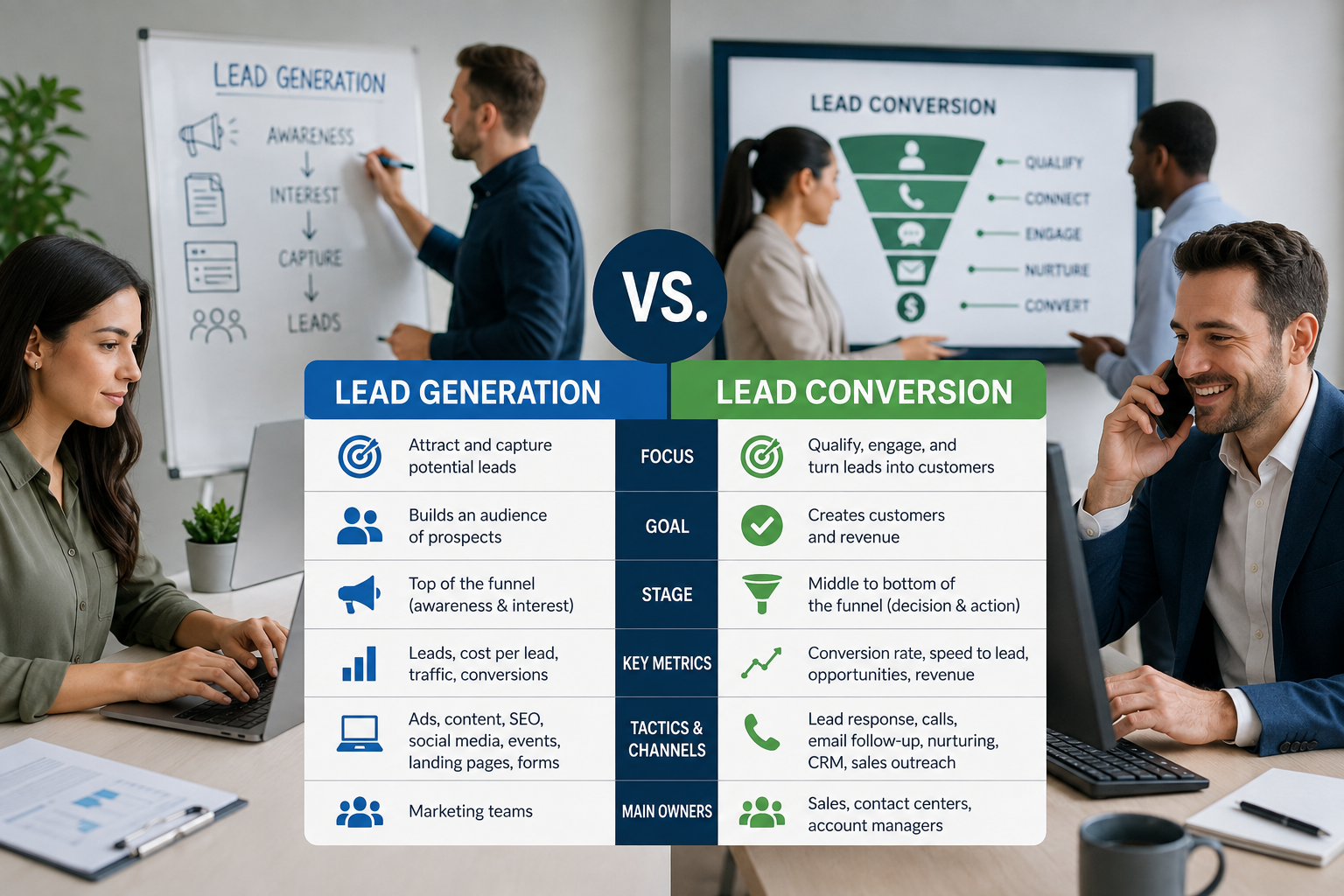
| Lead generation | Lead conversion | |
|---|---|---|
| Primary goal | Create potential opportunities | Turn opportunities into outcomes |
| Typical funnel stage | Top of funnel | Middle and bottom of funnel |
| Primary activity | Attract and capture interest | Qualify, engage, nurture and close |
| Typical output | Leads | Opportunities or customers |
| Common metrics | Leads, cost per lead, traffic | Conversion rate, opportunities, customers, revenue |
| Typical owners | Marketing and acquisition teams | Sales, contact centers and revenue teams |
| Examples | Ads, SEO, content, events, forms | Calls, follow-up, qualification, appointments, sales |
| Core question | “Who can we attract?” | “Who can we convert?” |
The two functions should not operate as separate worlds.
A strong lead-generation strategy should create opportunities that the conversion process can actually handle. And conversion data should flow back to marketing so the business can identify which sources produce valuable customers—not simply large numbers of leads.
How lead generation and lead conversion work together
Think of the relationship as a chain:
Attract → Capture → Qualify → Contact → Engage → Nurture → Convert → Revenue
Lead generation primarily influences the beginning of that chain.
Lead conversion primarily influences what happens afterward.
But there is significant overlap.
For example, marketing may generate an inbound form submission. Sales then qualifies the lead. A contact center calls the prospect. The prospect requests additional information. A salesperson follows up. The prospect eventually purchases.
Which team “owns” the conversion?
In a mature organization, the answer is usually less important than whether the entire journey can be measured.
The objective is to create a connected process where each team understands what happens before and after its own stage.
Why more leads do not necessarily mean more customers
Suppose two companies each generate 10,000 leads.
Company A converts 2% of them into customers.
Company B converts 6%.
Company A generates 200 customers.
Company B generates 600.
The second company did not necessarily need three times as many leads. It generated the same volume but extracted substantially more value from those opportunities.
This is why lead generation and lead conversion should be measured together.
Increasing lead volume can be useful when the existing conversion operation has capacity.
But if conversion is the bottleneck, additional leads can make the problem worse by creating more unanswered inquiries, delayed follow-up, overloaded sales teams, or poorly handled calls.
The metrics are different
One of the clearest differences between lead generation and lead conversion is what each team measures.
Lead generation metrics
Lead-generation teams commonly monitor metrics such as:
- Number of leads
- Cost per lead
- Click-through rate
- Landing-page conversion
- Traffic
- Form submissions
- Cost per acquisition
- Lead-source volume
These metrics help answer whether marketing activities are creating opportunities efficiently.
But they do not necessarily tell you whether those opportunities are valuable.
Lead conversion metrics
Conversion teams need a different set of measurements.
Useful metrics include:
- Lead-to-contact rate
- Lead-to-qualified rate
- Lead-to-opportunity rate
- Lead-to-customer conversion rate
- Speed-to-lead
- Time to conversion
- Appointment rate
- Close rate
- Revenue per lead
- Revenue per customer
For example, Salesforce’s documentation uses converted leads and total leads to calculate a lead conversion rate and also tracks measures such as average time to convert and conversion by lead source. (Salesforce)
The important point is that conversion metrics should be tied to a clearly defined stage.
A business should not call every form submission a customer conversion if the real commercial milestone occurs later.
Lead quality connects generation and conversion
Lead quality is where the distinction between generation and conversion becomes particularly important.
Marketing can generate a large volume of leads that look successful on a dashboard.
But sales may discover that many of those leads:
- Do not match the target market
- Are outside the service area
- Are not interested in the advertised product
- Cannot be contacted
- Have low purchase intent
- Were generated from poor-quality traffic
- Are duplicates
- Do not meet qualification requirements
In that situation, the problem may not be the sales team’s ability to convert.
The problem may begin with what marketing is generating.
The opposite can also happen.
A company can generate highly relevant, high-intent leads but fail to convert them because the response process is slow or inconsistent.
This is why lead quality and conversion performance should be analyzed together.
Where lead conversion typically breaks down
Once a lead has been generated, several things can prevent it from becoming revenue.
Slow response
A lead that expresses strong buying intent may expect a timely response.
If the organization waits too long, the opportunity can become harder to engage.
Poor lead routing
The right lead needs to reach the right person or team.
Routing can take into account geography, product, customer type, availability, specialization, or other business rules.
Weak qualification
Teams need a consistent definition of what makes a lead worth pursuing.
Without one, salespeople can spend time on poor-fit opportunities while high-value leads receive insufficient attention.
Inconsistent follow-up
Some prospects will not purchase after the first interaction.
A structured follow-up process helps distinguish genuine lost opportunities from prospects that simply need more time.
Weak conversations
Contact does not equal conversion.
A successful connection can still fail to produce a useful next step if the conversation does not address the prospect’s needs, objections, or buying stage.
Poor attribution
If a business cannot connect its lead source to downstream outcomes, it becomes difficult to determine which acquisition channels actually produce revenue.
Contact.io’s existing content similarly emphasizes the importance of call tracking, routing, and analysis for understanding marketing effectiveness and improving customer interactions. (Contact.Io)
How to improve both lead generation and lead conversion
The best results usually come from improving the handoff between the two.
1. Define what a qualified lead means
Marketing and sales should agree on the characteristics that make a lead worth pursuing.
This could include geography, product fit, intent, budget, timing, eligibility, or other criteria.
2. Measure beyond lead volume
Do not judge an acquisition source only by how many leads it produces.
Track what happens to those leads afterward.
A smaller source that produces more customers can be more valuable than a large source with poor downstream performance.
3. Improve speed-to-lead
Create processes that allow new opportunities to be identified, prioritized, routed, and contacted quickly.
This is particularly important for inbound calls and other high-intent interactions.
4. Strengthen lead routing
Use clear rules for deciding where different leads should go.
The objective should be effective matching, not simply equal distribution.
5. Connect marketing and sales data
Marketing needs visibility into downstream conversion.
Sales and contact center teams need visibility into lead source and campaign context.
Without that connection, each department may optimize its own numbers while the overall funnel underperforms.
6. Analyze conversations
For businesses where phone calls are central to the buying process, the conversation itself can reveal valuable information.
Call outcomes, qualification results, objections, customer questions, and successful interaction patterns can all help teams understand what drives conversion.
Contact.io’s current programming specifically focuses on tracking, routing, attribution, call performance analytics, lead response, contact center operations, and conversation-driven revenue. (Contact.Io)
Lead generation vs. lead conversion for call-driven businesses
The distinction becomes especially important when customer acquisition depends on phone conversations.
A lead may originate from a digital advertisement but become commercially valuable only when someone calls.
Alternatively, an inbound call itself may be the lead.
From there, the business needs to determine:
- Where the call originated
- Whether the caller fits the target customer
- How quickly the call was answered
- Where it was routed
- Whether the conversation was qualified
- Whether follow-up was required
- Whether the call produced an appointment, sale, or other outcome
This is where lead generation and lead conversion become one connected operational system.
Contact.io describes its audience as brands, buyers, call centers, agencies, platforms, and technology providers involved in inbound calls, pay-per-call, outbound lead response, contact center performance, compliance, and AI-powered customer contact. (Contact.Io)
Its focus is therefore not simply on creating demand. It is on what happens when that demand becomes a real customer conversation.
Which should businesses focus on: lead generation or lead conversion?
Usually, the answer is both—but not necessarily in equal proportions.
If your sales team has more capacity than leads, increasing qualified lead generation may be the priority.
If your marketing team produces substantial lead volume but sales struggles to keep up, improving conversion may create more value.
A useful diagnostic is to examine the funnel from both directions:
If we generated 20% more qualified leads, could our operation convert them?
And:
If we kept lead volume the same, where could we improve the percentage that becomes revenue?
The answers can reveal whether the next growth opportunity sits in acquisition, conversion, or the handoff between them.
A practical framework for aligning the two
A simple framework is to connect four layers:
Layer 1: Acquisition
Identify where leads come from and what each source costs.
Layer 2: Quality
Determine which leads meet your target criteria and demonstrate meaningful intent.
Layer 3: Conversion
Measure response, qualification, contact, engagement, appointments, opportunities, and customers.
Layer 4: Revenue
Connect converted customers back to their original lead sources and calculate the resulting economic value.
This creates a much more useful picture than a lead-volume report alone.
For example:
Campaign A → 1,000 leads → 100 qualified → 30 customers → $X revenue
Campaign B → 500 leads → 150 qualified → 50 customers → $Y revenue
Campaign B generated half as many leads but produced more customers.
Without conversion and revenue data, that difference would be invisible.
FAQ
Is lead generation the same as lead conversion?
No. Lead generation creates or captures potential customer opportunities. Lead conversion moves those opportunities toward a qualified opportunity, purchase, or other defined business outcome.
Which comes first, lead generation or lead conversion?
Lead generation generally comes first because it creates the opportunities that the conversion process works with. However, the two should operate as a connected feedback loop rather than completely separate processes.
Can you have good lead generation but poor lead conversion?
Yes. A business can generate relevant leads at scale but still struggle to convert them because of slow response, poor routing, weak qualification, inconsistent follow-up, or ineffective sales conversations.
Can improving lead conversion reduce the need for more leads?
Potentially. If a business has substantial lead volume but a weak conversion rate, improving the existing funnel can increase customers and revenue without requiring proportional growth in lead volume.
What is more important: lead quality or lead quantity?
Quality is usually more useful than raw volume when the objective is revenue. A smaller number of relevant, high-intent leads can outperform a much larger pool of poorly matched opportunities.
The bottom line
Lead generation creates opportunities. Lead conversion turns those opportunities into business results.
The strongest growth strategies treat both as parts of the same revenue system.
Marketing needs to understand what happens after a lead is generated. Sales and contact center teams need to understand where opportunities originate. Operations needs to ensure leads are routed and handled effectively. And leadership needs visibility from the original acquisition source all the way through customer and revenue outcomes.
For organizations that rely on calls and conversations, this connection becomes especially important. The point where a lead becomes a real conversation is often where acquisition strategy meets operational execution.
That is also where many of the biggest conversion opportunities—and gaps—can be found.
If your business depends on turning leads, calls, and customer conversations into revenue, explore Contact.io’s Lead Conversion Conference to connect with operators and decision-makers working across inbound calls, pay-per-call, lead response, contact center performance, compliance, and AI-powered customer contact. Contact.io’s current event positioning centers on exactly this intersection of lead acquisition, conversation performance, and revenue. (Contact.Io)
You can also use the Contact.io Conference Networking Impact Calculator to model how lead quality and conversion rates can affect the potential value of conference networking. (Contact.Io)