
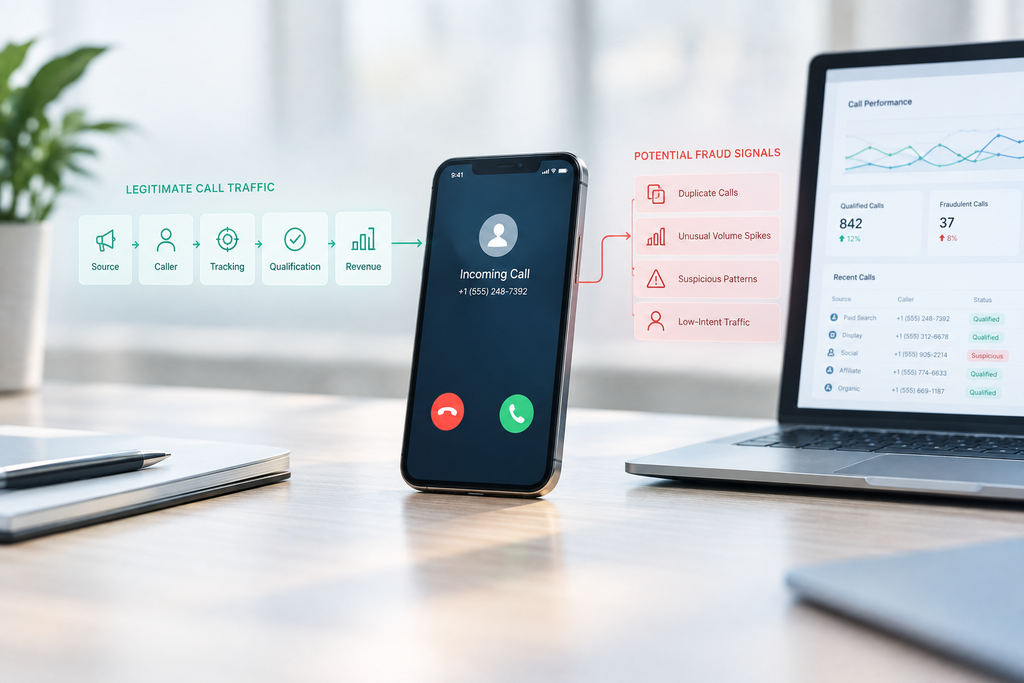
Pay-per-call marketing can create valuable connections between consumers and businesses, but the quality of that traffic matters.
When a pay-per-call program includes fraudulent, invalid, or intentionally misleading traffic, the consequences can extend beyond wasted spend. Buyers may pay for calls that do not represent genuine customer demand, publishers may face disputes over traffic quality, contact centers may spend resources handling unwanted interactions, and performance data can become difficult to trust.
That is why pay-per-call fraud prevention should be part of the broader call-quality strategy.
Fraud detection is not simply about identifying suspicious phone numbers or rejecting short calls. A strong prevention process combines source-level tracking, qualification criteria, attribution, anomaly detection, publisher controls, traffic analysis, and human review.
It is also important to distinguish fraudulent traffic from legitimate low-intent or poorly matched traffic. Not every unwanted call is fraudulent, and treating every quality problem as fraud can create its own problems.
This guide explains common warning signs of pay-per-call fraud, how buyers and publishers can investigate suspicious activity, and practical steps for building a stronger prevention process.
What Is Pay-Per-Call Fraud?
Pay-per-call fraud generally refers to deceptive, invalid, or prohibited activity intended to generate compensation or otherwise manipulate a pay-per-call program without producing the legitimate customer value the program is designed to acquire.
The exact definition can vary by campaign, contract, platform, industry, and applicable rules.
Potential examples can include:
- Artificially generated calls
- Repeated or duplicate interactions
- Calls designed primarily to trigger payment rather than create customer value
- Misleading traffic sources
- Manipulated campaign information
- Traffic that violates agreed campaign requirements
- Suspicious activity designed to exploit qualification or payout rules
- Other behavior that intentionally misrepresents the source or quality of calls
The important distinction is intent and evidence.
A call that does not convert is not automatically fraudulent.
A short call is not automatically fraudulent.
An unusual traffic pattern is not automatically fraudulent.
These can be warning signs that deserve investigation, but they are not necessarily proof of wrongdoing on their own.
Why Pay-Per-Call Fraud Matters
Pay-per-call campaigns depend on measurement.
A typical journey might look like:
Traffic Source → Consumer → Inbound Call → Qualification → Buyer → Customer → Revenue
If fraudulent or invalid interactions enter that process, they can distort several stages at once.
For example, suspicious traffic can:
- Increase call volume without increasing customers
- Increase acquisition costs
- Distort publisher performance
- Consume contact-center resources
- Reduce conversion rates
- Create disputes between buyers and publishers
- Pollute attribution data
- Make campaign optimization less reliable
- Hide the performance of legitimate traffic
The problem therefore goes beyond the individual call.
It can affect the quality of the entire pay-per-call measurement system.
Contact.io’s current pay-per-call programming treats call quality, fraud prevention, tracking, attribution, routing, and conversion as connected parts of the ecosystem.
Fraud vs. Low-Intent Traffic vs. Poor Lead Quality
One of the most important principles in pay-per-call fraud prevention is understanding that not every bad call is fraudulent.
There are at least three different problems a buyer may encounter.
Fraudulent traffic
Traffic may involve deliberate manipulation, deception, or activity intended to improperly generate compensation or violate program rules.
Low-intent traffic
The caller may be a real consumer but have little interest in taking the desired action.
For example, someone may call simply to ask a general question.
Poorly matched traffic
The caller may have genuine intent but not meet the campaign’s requirements.
For example:
- The caller is outside the eligible geography.
- The caller wants a different product.
- The caller is an existing customer.
- The service is unavailable in the caller’s location.
- The advertisement created an incorrect expectation.
These situations can all reduce campaign performance, but they require different responses.
Fraud prevention should therefore be about investigating evidence, not simply labeling every unwanted call as fraud.
1. Watch for Unusual Call-Volume Spikes
Sudden changes in call volume can be useful signals.
For example, a publisher that normally generates 100 calls per day might suddenly generate 2,000 without an obvious campaign, seasonal, or market explanation.
That does not prove fraud.
There may be a legitimate reason:
- A campaign was scaled.
- A new advertising channel launched.
- A major event increased demand.
- A publisher changed its media strategy.
- A product became temporarily more popular.
- A new partner began sending traffic.
The key is to investigate the change.
Compare the volume spike with:
- Campaign activity
- Publisher activity
- Geographic distribution
- Call outcomes
- Qualification rate
- Conversion rate
- Caller patterns
- Traffic-source data
- Revenue
A volume spike combined with unusual quality changes may deserve closer attention than a volume spike by itself.
2. Look for Repeated or Duplicate Calls
Repeated interactions can sometimes indicate legitimate behavior.
A consumer might call multiple times because:
- The first call was disconnected.
- The consumer did not reach the right department.
- The caller wants to follow up.
- The caller is comparing options.
- The contact center was unavailable.
But unusually repetitive calling patterns can also be a warning signal.
Look for patterns such as:
- The same number generating large numbers of calls
- Repeated calls within unusually short intervals
- Multiple calls with identical or highly similar behavior
- Repeated calls that consistently fail qualification
- Large numbers of interactions tied to a small group of identifiers
The objective is not to automatically reject repeated callers.
It is to identify patterns that deserve investigation.
3. Monitor Extremely Short Calls
Very short calls can sometimes be associated with low-quality or suspicious traffic.
For example, a campaign may suddenly produce an unusually large number of calls that connect and terminate almost immediately.
However, duration alone is not enough to determine whether traffic is fraudulent.
Short calls can occur for legitimate reasons:
- The caller dialed the wrong number.
- The caller changed their mind.
- The agent answered too late.
- The call dropped.
- The caller reached an unexpected destination.
- The consumer had a simple question.
- The contact center experienced a technical issue.
That means call duration should be treated as one signal among several.
For a broader discussion of why call duration should not be used as the only quality measure, see How to Improve Pay-Per-Call Lead Quality.
4. Examine Geographic Anomalies
Geographic targeting is often an important part of pay-per-call campaigns.
If a campaign is designed for specific states, cities, or service areas, unexpected geographic patterns may deserve attention.
For example:
- A large increase in calls from outside the target area
- Unusual concentration of traffic from one location
- Traffic inconsistent with the campaign’s targeting
- Geographic patterns that differ significantly from historical performance
Again, an anomaly is not automatically fraud.
It may indicate a targeting problem, a tracking issue, a routing problem, or an incorrectly configured campaign.
The correct response is to investigate the underlying cause.
5. Compare Call Quality by Source
One of the strongest ways to identify suspicious activity is to analyze performance at the source level.
A pay-per-call program may involve:
- Publishers
- Affiliates
- Agencies
- Networks
- Paid-search campaigns
- Display campaigns
- Social campaigns
- Organic traffic
- Partner channels
If all calls are combined into one report, unusual behavior from one source may be hidden by the overall campaign results.
Source-level analysis can reveal:
- Qualification rate
- Rejection rate
- Conversion rate
- Call duration
- Customer rate
- Revenue per call
- Geographic distribution
- Repeat-call patterns
- Traffic spikes
This is where reliable call tracking becomes particularly valuable.
The Contact.io article Call Tracking and Attribution for Pay-Per-Call Campaigns explains how tracking can connect inbound calls with sources, campaigns, publishers, outcomes, and revenue.
Fraud prevention becomes much harder when the business cannot determine where its calls originated.
6. Analyze Quality Changes, Not Just Volume Changes
A source can increase call volume without necessarily increasing valuable customer conversations.
For example:
Before
- 500 calls
- 250 qualified
- 75 customers
After
- 1,000 calls
- 260 qualified
- 72 customers
Call volume doubled.
Qualified calls barely increased.
Customers actually declined.
That pattern does not automatically prove fraud.
But it does indicate that something changed in the traffic or conversion process.
Possible explanations include:
- A new traffic source
- Different targeting
- Poorer-quality placements
- A campaign expansion
- Seasonal behavior
- Changes in consumer demand
- Contact-center capacity
- Routing problems
- Potentially suspicious traffic
This is why quality ratios can be more informative than raw volume.
7. Watch for Suspicious Publisher Patterns
Publisher-level monitoring can help buyers identify unusual behavior.
Potential warning signs include:
- Sudden unexplained traffic growth
- Large changes in geographic mix
- Sharp declines in qualification rates
- Unusual repeat-caller patterns
- Traffic concentrated in unusual time periods
- Significant differences between publisher-reported and buyer-reported results
- Campaign identifiers that do not match expected patterns
- Large volumes of calls with little downstream value
None of these automatically establishes fraud.
They are signals that can help prioritize investigation.
A mature pay-per-call program should combine several signals rather than relying on a single threshold.
8. Use Consistent Qualification Rules
Clear qualification rules are one of the strongest preventative controls available to buyers.
Before launching a campaign, establish:
- Geographic requirements
- Customer eligibility
- Product requirements
- Call-duration rules where appropriate
- Intent requirements
- New-versus-existing-customer rules
- Duplicate-call treatment
- Accepted call hours
- Disallowed traffic sources
- Dispute procedures
- Reporting requirements
When qualification rules are unclear, disagreements become more likely.
Publishers may believe they are delivering acceptable traffic while buyers believe the traffic is invalid.
Clear definitions create a common framework for measurement.
For more on defining and improving qualified calls, see How to Improve Pay-Per-Call Lead Quality.
9. Track the Entire Customer Journey
Fraud prevention should not stop at the moment the phone rings.
A stronger measurement chain looks like:
Source → Call → Qualification → Conversation → Opportunity → Customer → Revenue
This makes it possible to identify situations where a source generates:
- Large call volume
- Low qualification
- Low conversion
- Little customer value
It also helps distinguish a traffic-quality problem from a downstream conversion problem.
For example, if calls are consistently qualified but rarely convert, the issue may be:
- Contact-center performance
- Sales execution
- Product fit
- Pricing
- Routing
- Follow-up
- Customer experience
That is very different from a source generating calls that never meet the campaign’s requirements.
The existing Contact.io article How Brands Buy and Convert Inbound Calls explores this broader process from call acquisition through qualification, conversion, and revenue.
10. Establish Source-Level Attribution
Attribution helps answer a basic but important question:
Where did this call come from?
Useful source information can include:
- Publisher
- Affiliate
- Campaign
- Ad
- Keyword
- Landing page
- Geographic segment
- Partner
- Traffic channel
The more accurately calls can be attributed, the easier it becomes to identify unusual behavior.
Attribution also protects legitimate publishers.
If a buyer can identify exactly which source produced a questionable interaction, it is easier to investigate that specific source rather than making assumptions about an entire partner relationship.
For more on the distinction between acquisition infrastructure and measurement infrastructure, see Pay-Per-Call Networks vs. Call Tracking Platforms.
11. Compare Multiple Fraud Signals
A strong fraud-prevention process should avoid relying on one rule.
Instead, consider combinations of signals.
For example:
Signal 1: unusual call spike
Signal 2: unusually low qualification rate
Signal 3: high concentration from a small geographic area
Signal 4: repeated caller patterns
Signal 5: low downstream customer conversion
One signal alone may be harmless.
Several signals occurring together may justify deeper investigation.
This approach can reduce false positives while still helping teams identify unusual activity.
12. Create an Investigation Process
When suspicious activity is detected, teams should have a defined process.
A basic investigation might include:
Step 1: Identify the affected traffic
Determine which publisher, campaign, source, or period is involved.
Step 2: Review the call data
Look at:
- Time
- Duration
- Source
- Geography
- Destination
- Qualification
- Outcome
Step 3: Compare with historical performance
Determine whether the behavior is genuinely unusual.
Step 4: Look for multiple signals
Check whether other indicators support the concern.
Step 5: Review the customer outcome
Determine whether the interactions produced legitimate opportunities or customers.
Step 6: Investigate the source
If appropriate, request additional information from the publisher, network, or partner.
Step 7: Document the finding
Keep a record of the evidence and decision.
Step 8: Take proportionate action
Depending on the findings, the response might include:
- Monitoring
- Campaign adjustment
- Traffic-source restrictions
- Qualification changes
- Publisher review
- Temporary suspension
- Commercial dispute
- Further investigation
The appropriate response depends on the evidence and the campaign’s agreements.
13. Give Publishers Clear Feedback
Fraud prevention should not be purely punitive.
Publishers need to understand what buyers are seeing.
For example, instead of saying:
“Your traffic is fraudulent.”
a buyer might communicate:
“We observed a significant increase in calls from this source, a sharp decline in qualification rate, and a concentration of repeated calls during a specific period. Can you help us understand the change?”
That creates an opportunity to investigate before reaching a conclusion.
The publisher may discover:
- A campaign configuration error
- A new advertising partner
- Incorrect targeting
- A tracking problem
- A landing-page issue
- A genuine traffic-quality problem
Clear communication can protect relationships while improving campaign quality.
14. Vet New Publishers and Partners
Prevention can begin before a single call is generated.
When evaluating a new publisher or partner, buyers can ask:
- Where does the traffic originate?
- Which advertising channels are used?
- What customer audience is being targeted?
- How is traffic monitored?
- How are sources identified?
- What quality controls are used?
- How are prohibited traffic sources handled?
- How are duplicate calls identified?
- How are disputes managed?
- What reporting is available?
The objective is not to eliminate every possible risk.
It is to establish enough transparency to understand where calls are coming from and how quality is being managed.
15. Make Traffic Sources Transparent
The more opaque the traffic source, the harder it is to investigate problems.
A mature pay-per-call program should aim to preserve useful source information throughout the acquisition journey.
For example:
Publisher → Campaign → Traffic Source → Consumer → Call → Buyer → Outcome
This creates a chain of accountability.
It also makes optimization easier.
If a source begins producing suspicious activity, the buyer can investigate that specific path instead of making broad assumptions about the entire campaign.
16. Use Call Tracking as a Fraud-Prevention Tool
Call tracking is not a fraud-detection system by itself.
But it provides information that can support fraud investigation.
Tracking can help capture:
- Caller information where appropriate
- Call timestamp
- Duration
- Source
- Campaign
- Destination
- Geographic information
- Connection status
- Call outcome
When those data points are analyzed together, unusual patterns become easier to identify.
This is another reason reliable measurement is foundational to pay-per-call fraud prevention.
The goal is not simply to record more calls.
It is to make those interactions understandable.
17. Use Attribution to Connect Suspicious Activity to Revenue
Fraud prevention becomes more useful when connected to business outcomes.
Suppose a publisher generates:
1,000 calls → 400 qualified calls → 100 customers
Another publisher generates:
1,500 calls → 150 qualified calls → 30 customers
The second publisher generated more calls but substantially fewer qualified calls and customers.
That does not prove fraud.
But it tells the buyer that something about the traffic or downstream process deserves investigation.
Revenue attribution provides another layer of context.
If a source generates large volumes of calls but very little customer revenue, the buyer can investigate whether the problem comes from:
- Traffic quality
- Qualification
- Routing
- Contact-center performance
- Product mismatch
- Sales execution
- Fraud
- Another factor
18. Be Careful With AI-Based Fraud Detection
AI can potentially help identify patterns across large volumes of call data.
Applications may include:
- Anomaly detection
- Caller-pattern analysis
- Conversation classification
- Intent analysis
- Quality assurance
- Pattern recognition
- Automated alerts
For example, an AI system might flag a source because its call behavior differs significantly from historical patterns.
That can be useful.
But an AI-generated risk signal is not the same as proof of fraud.
AI systems can produce false positives, miss relevant context, or classify legitimate unusual behavior incorrectly.
Human review and clear investigation procedures remain important.
For a broader discussion of AI across pay-per-call marketing, see How AI Is Changing Pay-Per-Call Marketing.
19. Protect Against False Positives
Fraud prevention can create problems if legitimate traffic is incorrectly rejected.
For example, an unusual call pattern might be caused by:
- A major advertising event
- A seasonal change
- A viral campaign
- A new customer segment
- A legitimate geographic shift
- A technical issue
- A contact-center problem
If a buyer automatically blocks every unusual source, it may eliminate legitimate opportunities.
That is why investigation should consider:
What changed?
Why did it change?
Is the change supported by other evidence?
What happened to the resulting customers?
This approach creates a more balanced fraud-prevention process.
20. Monitor Fraud Risk Continuously
Fraud prevention should not be a one-time audit.
Traffic changes.
Publishers change.
Campaigns change.
Advertising platforms change.
Consumer behavior changes.
New technologies can also introduce new forms of manipulation.
That means buyers should continuously monitor:
- Call volume
- Qualification rate
- Source performance
- Geographic distribution
- Caller patterns
- Call duration
- Conversion
- Revenue
- Publisher-level changes
- Unusual spikes or drops
Regular monitoring makes it easier to identify changes before they become larger problems.
Common Pay-Per-Call Fraud Warning Signs
There is no universal checklist that proves a call is fraudulent, but the following patterns can justify investigation:
1. Sudden unexplained call spikes
Call volume changes dramatically without a corresponding campaign or market explanation.
2. Unusual repeat-caller activity
A small number of callers generate a disproportionate number of interactions.
3. Abnormally high short-call rates
A source begins generating an unusual concentration of extremely short interactions.
4. Geographic inconsistencies
Traffic appears outside the campaign’s intended geographic profile.
5. Sharp qualification-rate changes
A source that historically performed well suddenly produces mostly unqualified calls.
6. Large source-level discrepancies
One publisher or campaign performs dramatically differently from comparable sources without an obvious explanation.
7. High call volume with little downstream value
Calls increase while qualified opportunities, customers, and revenue remain flat or decline.
8. Unusual timing patterns
Traffic becomes concentrated in unusual periods without a clear business explanation.
9. Suspicious source changes
Performance shifts immediately after a publisher introduces a new traffic source, partner, or campaign.
10. Data inconsistencies
Reported source, campaign, call, or conversion information does not align across systems.
Again, these are warning signs, not automatic proof of fraud.
Pay-Per-Call Fraud Prevention Checklist
A practical prevention program can include:
- Define qualified calls clearly.
- Establish prohibited traffic rules.
- Track calls at the source level.
- Use consistent campaign identifiers.
- Monitor publisher performance.
- Compare quality metrics over time.
- Watch for unusual call-volume changes.
- Analyze geographic patterns.
- Monitor repeat callers.
- Track downstream outcomes.
- Connect calls to customers and revenue.
- Establish a publisher investigation process.
- Document disputed interactions.
- Review unusual activity before taking action.
- Use multiple fraud signals together.
- Apply AI as a supporting tool rather than unquestionable evidence.
- Audit the program regularly.
How Buyers and Publishers Can Reduce Fraud Together
Fraud prevention is not only the buyer’s responsibility.
Publishers and other acquisition partners also benefit from maintaining traffic quality.
Buyers can:
- Define qualification criteria.
- Provide clear campaign requirements.
- Track source-level performance.
- Communicate quality problems.
- Establish dispute procedures.
- Review suspicious activity consistently.
Publishers can:
- Monitor their traffic sources.
- Vet downstream partners.
- Avoid misleading advertising.
- Maintain accurate campaign information.
- Investigate unusual traffic.
- Communicate material changes.
- Monitor their own call quality.
Networks and intermediaries can:
- Establish transparent rules.
- Monitor source behavior.
- Support dispute resolution.
- Provide useful reporting.
- Help connect buyers and publishers around shared quality standards.
This creates a stronger ecosystem than simply shifting responsibility from one participant to another.
Pay-Per-Call Fraud and the Broader Lead-Quality Problem
Fraud is only one part of the broader pay-per-call quality challenge.
A campaign can perform poorly because of:
- Fraud
- Low-intent traffic
- Poor targeting
- Incorrect messaging
- Geographic mismatch
- Weak qualification
- Poor routing
- Contact-center issues
- Slow response
- Weak follow-up
- Product mismatch
That is why fraud prevention should exist within a broader lead-quality strategy.
The Contact.io article How to Improve Pay-Per-Call Lead Quality explores this larger challenge, including qualification, source evaluation, routing, attribution, low-intent traffic, and downstream conversion.
The goal is to understand why a call is failing rather than simply labeling every unsuccessful interaction as fraud.
Pay-Per-Call Fraud and Call Tracking
Tracking and fraud prevention are closely connected.
Without reliable tracking, a buyer may know that a suspicious call occurred but not know:
- Where it came from
- Which campaign generated it
- Which publisher was responsible
- What happened after the call
- Whether similar calls came from the same source
That makes investigation much harder.
The current Contact.io article Call Tracking and Attribution for Pay-Per-Call Campaigns explains how tracking connects calls with sources, campaigns, publishers, outcomes, and revenue.
This measurement layer can support both optimization and fraud investigation.
Pay-Per-Call Fraud and Contact-Center Operations
Fraud prevention also intersects with contact-center performance.
A suspicious or low-quality call can consume:
- Agent time
- Queue capacity
- Transfer capacity
- Quality-assurance resources
- Management attention
If a contact center is already operating near capacity, a significant increase in unwanted calls can create operational pressure.
This is another reason to evaluate fraud and traffic quality as part of the complete customer-contact process.
The current Contact.io Pay-Per-Call Conference includes contact-center performance alongside call quality, fraud prevention, tracking, routing, attribution, compliance, and conversion.
How Contact.io Fits Into the Fraud-Prevention Conversation
Pay-per-call fraud is not an isolated technology problem.
It sits at the intersection of:
- Marketing
- Publisher relationships
- Call acquisition
- Tracking
- Attribution
- Routing
- Contact-center operations
- Compliance
- Analytics
- Customer conversion
That is why Contact.io brings together brands, call buyers, publishers, agencies, contact centers, networks, and technology providers around these connected challenges.
The current Contact.io 2027 event is scheduled for August 23–24, 2027, at the Seminole Hard Rock Hotel & Casino Hollywood in Hollywood, Florida. Its current programming includes call quality and fraud prevention, tracking and attribution, intelligent routing, buyer and publisher relationships, AI-powered voice technology, compliance, and converting calls into customers.
For professionals working to improve the quality and economics of inbound calls, these conversations are closely connected.
Frequently Asked Questions
What is pay-per-call fraud?
Pay-per-call fraud refers to deceptive, invalid, or prohibited activity that can manipulate a pay-per-call program or generate compensation without delivering the legitimate customer value the campaign is designed to acquire.
What are common signs of pay-per-call fraud?
Potential warning signs include unexplained call-volume spikes, unusual repeat-caller activity, abnormal short-call patterns, geographic inconsistencies, sudden quality changes, suspicious source behavior, and large differences between call volume and downstream customer outcomes.
None of these signals automatically proves fraud.
Is every short call fraudulent?
No. Short calls can happen for many legitimate reasons, including wrong numbers, dropped calls, simple customer questions, or contact-center issues. Duration should be considered alongside other signals.
How can I prevent pay-per-call fraud?
Start with clear qualification rules, source-level tracking, reliable attribution, publisher controls, regular performance monitoring, anomaly detection, investigation procedures, and consistent dispute processes.
How does call tracking help prevent fraud?
Call tracking can provide information about where calls originated, when they occurred, how long they lasted, where they were routed, and what happened afterward. That information can help identify unusual patterns and investigate suspicious traffic.
Can AI detect pay-per-call fraud?
AI can potentially help identify unusual patterns and prioritize calls or sources for review. However, AI-generated risk signals should not automatically be treated as proof of fraud. Human investigation and appropriate evidence remain important.
What is the difference between fraudulent traffic and low-intent traffic?
Fraudulent traffic involves potentially deceptive or prohibited activity, while low-intent traffic may come from legitimate consumers who simply are not good prospects for the campaign. The appropriate response can be very different for each.
How should buyers handle suspected fraudulent traffic?
Buyers should document the evidence, identify the affected source, compare the activity with historical performance, review multiple signals, communicate with the relevant partner where appropriate, and follow the campaign’s agreed dispute and investigation process.
Conclusion: Better Fraud Prevention Starts With Better Visibility
Pay-per-call fraud can undermine campaign economics, distort performance data, and create unnecessary pressure across the customer-acquisition and contact-center process.
But fraud prevention does not have to mean rejecting every unusual call.
The stronger approach is to build a system that makes unusual behavior visible and gives teams the information they need to investigate it.
That means:
- Define what a qualified call means.
- Track calls at the source level.
- Use consistent attribution.
- Monitor publisher performance.
- Watch for unusual patterns.
- Compare quality metrics over time.
- Connect calls to customers and revenue.
- Distinguish fraud from low-intent and poorly matched traffic.
- Use AI and analytics as supporting tools.
- Give legitimate partners an opportunity to investigate unexpected changes.
- Document decisions and apply rules consistently.
The goal is not simply to eliminate suspicious calls.
It is to create a pay-per-call ecosystem where buyers can trust their data, publishers understand quality expectations, and legitimate customer conversations are protected from being lost among low-quality traffic.
The strongest programs connect the entire journey:
Right source → Genuine caller → Qualified conversation → Right destination → Customer → Revenue
That is where fraud prevention becomes part of a larger pay-per-call performance strategy.
For more on the broader ecosystem of inbound calls, pay-per-call marketing, tracking, routing, attribution, call quality, and conversion, visit Contact.io.
Where conversations turn into revenue.