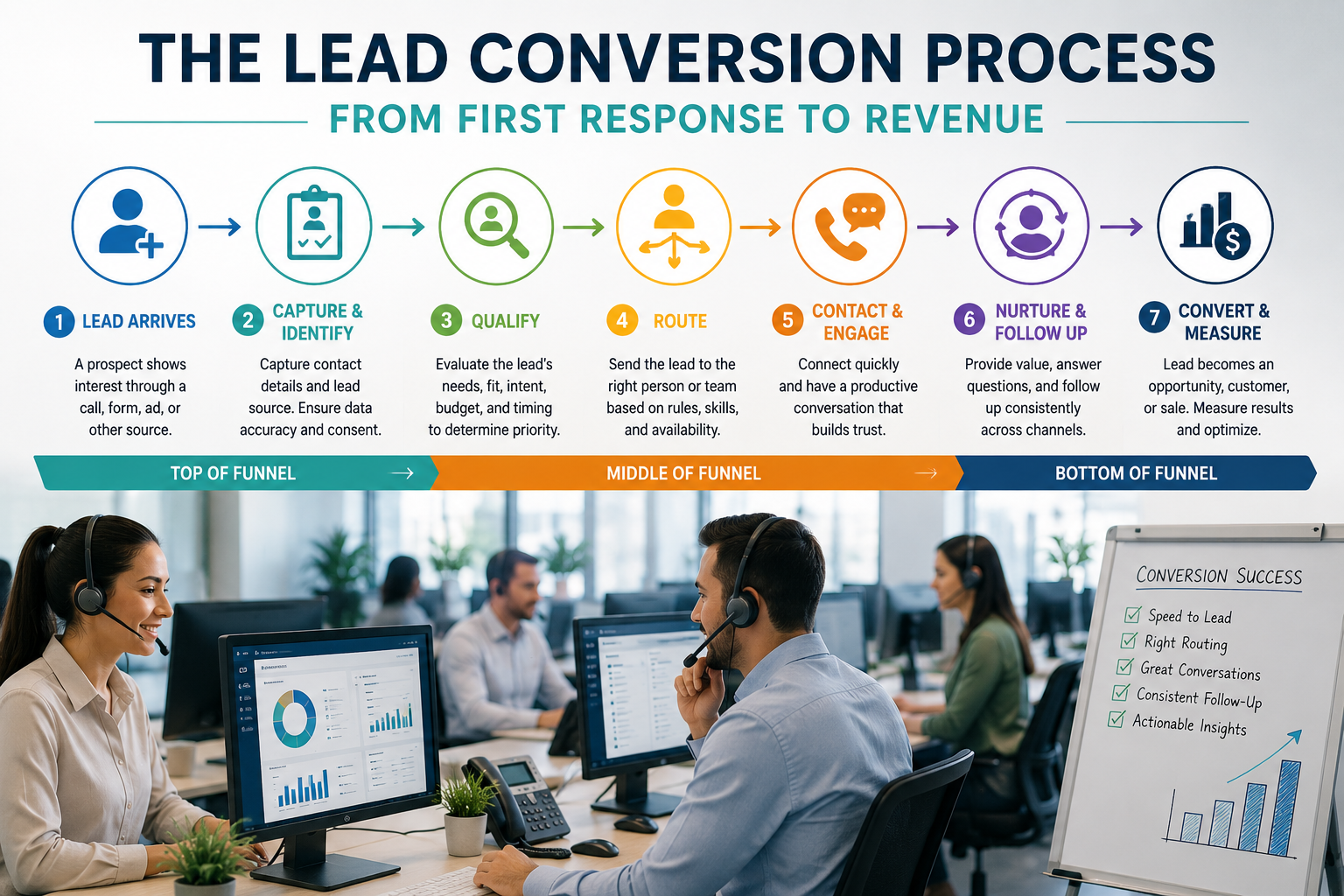
The Lead Conversion Process: From First Response to Revenue
September 1, 2026 0 comment
A lead conversion process is the sequence of actions a business uses to turn initial customer interest into a qualified opportunity, customer, or revenue-generating outcome. It typically begins when a lead arrives, continues through identification, qualification, routing, contact, engagement, and follow-up, and ends when the business records the appropriate conversion and measures the result.
The exact stages vary by business. A B2B company may move a lead into an opportunity before a sale, while an inbound call center may define conversion as a qualified call, appointment, or completed sale. What matters is having a clearly defined process that connects the first response to the final commercial outcome.
For businesses that depend on inbound calls, pay-per-call, outbound lead response, or contact centers, the process is particularly important because every handoff can affect whether an interested prospect becomes a productive conversation—and whether that conversation becomes revenue.
What is the lead conversion process?
The lead conversion process is the operational journey between a prospect showing interest and reaching a defined business outcome.
A practical version looks like this:
Lead arrives → Capture and identify → Qualify → Route → Contact and engage → Nurture and follow up → Convert and measure
Not every business will use these exact labels. Some organizations combine qualification and routing. Others add stages for appointment setting, proposals, demonstrations, negotiations, or closed-won opportunities.
Salesforce describes lead management as a process that moves leads through different phases of the conversion cycle, from initial contact through sales and after the close. Its documentation also describes converting qualified leads into contacts, accounts, and opportunities.
The important principle is that lead conversion should be treated as a process, not a single event.
A lead does not become valuable merely because it entered a CRM or because somebody attempted to call it. Each stage should move the opportunity closer to the outcome the business is trying to achieve.
The 7 stages of the lead conversion process
1. A lead arrives
Every conversion process starts with an expression of interest.
The lead might arrive through:
- A website form
- A paid advertisement
- Organic search
- A referral
- An event
- A social campaign
- An inbound phone call
- A click-to-call advertisement
- A pay-per-call campaign
- Outbound prospecting
- A partner or publisher
At this stage, the business knows that someone has expressed potential interest. It does not yet know whether the person is qualified, reachable, ready to buy, or even a good fit.
That distinction is important.
A lead is an opportunity to evaluate—not a guaranteed customer.
The first objective is therefore to capture the information needed to make an intelligent next decision.
2. Capture and identify the lead
Once a lead arrives, the organization needs to identify and record it accurately.
Depending on the business, that can include:
- Name
- Phone number
- Email address
- Company
- Geographic location
- Product or service of interest
- Lead source
- Campaign
- Time of inquiry
- Previous interactions
- Consent information where applicable
- Relevant qualification data
This stage creates the foundation for everything that follows.
If the business cannot identify where a lead came from, it becomes difficult to evaluate acquisition performance. If contact information is incomplete or inaccurate, follow-up becomes harder. If important context is lost between marketing and sales, the eventual conversation may be less relevant.
Salesforce’s lead-management documentation specifically emphasizes lead capture, custom lead fields, assignment rules, and preserving information as leads move into contacts, accounts, and opportunities.
For call-driven businesses, identification can happen in real time. A call can provide information about the source, caller, campaign, location, and intent before or during the conversation.
That information can then inform what happens next.
3. Qualify the lead
The third stage is determining whether the lead is worth pursuing and what level of attention it deserves.
Qualification criteria depend on the business.
A company might evaluate:
- Customer need
- Product or service fit
- Geographic eligibility
- Budget
- Purchase intent
- Timing
- Decision-making authority
- Existing customer status
- Campaign or product eligibility
Salesforce recommends assessing factors such as a lead’s needs, budget, buying authority, and fit when qualifying opportunities.
Qualification is not simply about rejecting bad leads.
It helps the business answer:
What should happen to this lead next?
A high-intent prospect who fits the ideal customer profile may need immediate human contact.
A lower-intent prospect may be better suited to nurturing.
A lead that does not meet basic eligibility criteria may not belong in the active sales process at all.
The better the qualification logic, the more effectively the organization can allocate its limited sales and contact-center capacity.
4. Route the lead to the right destination
Once a lead has been qualified—or enough information is available to determine its next step—it needs to reach the appropriate person, team, or workflow.
Routing rules can consider:
- Geography
- Product
- Language
- Customer type
- Lead value
- Agent specialization
- Availability
- Business hours
- Campaign
- Previous customer relationship
- Qualification status
The objective is not necessarily to distribute leads equally.
It is to match the opportunity with the destination most capable of handling it effectively.
This becomes particularly important for inbound calls.
A caller asking about a specialized product may be better served by an agent with relevant expertise. A lead from a specific region may need to reach a local team. A high-value opportunity may require a senior representative.
Contact.io has previously covered advanced routing approaches including skill-based, geographic, time-based, queue-based, and behavioral routing.
Routing therefore sits at an important point between lead management and conversion performance.
A lead can be high quality and highly motivated, but a poor routing decision can still create friction at the moment when the business needs to respond.
5. Contact and engage the lead
Now the process moves from lead data to an actual interaction.
The first contact may happen through:
- Phone
- SMS
- Messaging
- A scheduled meeting
- A sales call
- A live transfer
- An automated conversation followed by human handoff
The objective is not simply to make contact.
It is to create a productive interaction.
That means understanding why the prospect reached out, confirming relevant information, answering questions, identifying needs, and determining the appropriate next step.
For phone-based businesses, this is where the concept of speed-to-lead becomes especially important.
But speed alone is not enough.
Contact.io’s existing discussion of speed-to-conversation argues that businesses increasingly need to focus not only on responding quickly but on getting to a meaningful conversation.
That distinction is useful.
A business can respond in seconds with an irrelevant message and still fail to convert.
A better process combines speed with context.
The person or system making contact should have enough information to understand why the lead entered the funnel and what the likely next action should be.
6. Nurture and follow up
Not every lead is ready to convert during the first interaction.
Some prospects need:
- More information
- A product demonstration
- A quote
- Internal approval
- A follow-up call
- Additional research
- A reminder
- Time to compare alternatives
This is where lead nurturing and follow-up become part of the conversion process.
Salesforce describes lead management as a bridge between marketing and sales and emphasizes nurturing and continued engagement after lead generation.
The follow-up process should answer several operational questions:
Who owns the lead?
When should the next contact happen?
Which channel should be used?
What information should the prospect receive?
What event moves the lead forward?
When should the lead be considered inactive or disqualified?
Without clear answers, follow-up can become inconsistent.
One salesperson may call three times. Another may send an email and stop. A third may leave the lead untouched because ownership is unclear.
A structured process makes follow-up repeatable.
Contact.io has also highlighted the importance of prioritizing lead follow-ups based on signals such as engagement, behavior, fit, and previous interactions rather than relying solely on a first-in, first-out approach.
That is an important evolution in lead management:
The goal is not simply to follow up quickly. It is to follow up intelligently.
7. Convert and measure the outcome
The final stage is reaching the business-defined conversion point and recording what happened.
That might mean:
- Qualified opportunity
- Appointment
- Demonstration
- Quote
- Contract
- Sale
- New customer
- Renewal
- Revenue
Salesforce’s official documentation describes converting qualified leads into contacts, accounts, and opportunities as part of moving the sales process forward.
But the operational process should not stop at “converted.”
The business also needs to measure the outcome.
Useful measurements include:
- Lead-to-contact rate
- Lead-to-qualified rate
- Lead-to-opportunity rate
- Lead-to-customer conversion rate
- Speed-to-lead
- Time to conversion
- Appointment rate
- Close rate
- Revenue per lead
- Revenue per customer
- Conversion by lead source
These measurements reveal whether the process is working—and where it is failing.
A simple example of the lead conversion process
Consider a home services company running paid advertising.
A potential customer clicks an advertisement and submits a request for service.
The process could look like this:
1. Lead arrives: The customer submits the request.
2. Capture: The CRM records the customer’s contact details, service type, location, campaign, and time of inquiry.
3. Qualification: The system confirms that the customer’s location and requested service are within the company’s target criteria.
4. Routing: The opportunity is assigned to an available representative who handles that service area.
5. Contact: The representative calls the customer and discusses the request.
6. Follow-up: If the customer is not ready to schedule immediately, the representative follows the defined follow-up sequence.
7. Conversion: The customer books the service. The business records the outcome and attributes the customer back to the originating campaign.
That last step is important.
Without attribution, the company may know it made a sale but not know which marketing activity created the opportunity.
Where leads are commonly lost
The lead conversion process creates multiple potential failure points.
Leads are not contacted
A lead can enter the system but never receive a meaningful response.
Possible causes include:
- Poor notifications
- Assignment failures
- Incorrect contact information
- Limited staffing
- Unclear ownership
- System integration problems
Leads are contacted too slowly
Even when a business eventually responds, a delay can create unnecessary friction.
The longer the gap between demonstrated interest and meaningful engagement, the more opportunities there may be for the prospect to move elsewhere.
Leads are routed incorrectly
A lead may reach an agent who lacks the appropriate knowledge, authority, availability, or specialization.
That can create transfers, delays, repeated explanations, and poor customer experiences.
Leads are poorly qualified
If qualification rules are too broad, sales teams waste resources on poor-fit opportunities.
If they are too restrictive, valuable opportunities may be discarded.
Conversations do not progress
A successful connection does not automatically mean a successful conversion.
The conversation needs to uncover the prospect’s needs and establish an appropriate next step.
Follow-up stops too early
A prospect who does not buy immediately may still become a customer.
Without a defined follow-up process, those opportunities can disappear from view.
Outcomes are not measured
If the business records only lead volume, it cannot reliably determine which sources, teams, campaigns, or processes are producing revenue.
How to improve the lead conversion process
Improvement should begin with the entire journey rather than one isolated metric.
Define every stage
Write down exactly what each stage means.
For example:
New → Contacted → Qualified → Engaged → Appointment → Opportunity → Customer
Your organization may need different stages, but each should have a clear definition.
Avoid vague statuses such as “working” if they do not tell another team member what actually happened.
Establish response-time expectations
Define how quickly different lead types should receive attention.
A high-intent inbound call may require immediate handling.
A lower-intent content lead may enter a different workflow.
The important thing is to establish expectations rather than allowing response time to depend entirely on individual behavior.
Build better routing rules
Review how leads are assigned.
Ask:
- Are high-value leads prioritized?
- Are leads reaching the appropriate specialists?
- Are routing rules based on current availability?
- Are geographic or product requirements respected?
- What happens when the preferred destination is unavailable?
Routing should be treated as a conversion decision, not merely an administrative function.
Give representatives context
A representative should know enough about the lead to make the first interaction relevant.
Useful context can include:
- Source
- Campaign
- Product interest
- Previous interactions
- Qualification data
- Relevant customer information
- Reason for inquiry
The more context a representative has, the less time the prospect may need to spend repeating information.
Standardize follow-up
Create clear sequences for leads that do not convert immediately.
For each stage, determine:
- Owner
- Timing
- Channel
- Message
- Next action
- Exit condition
The process can still allow personalization. Standardization simply ensures that opportunities do not depend entirely on individual memory.
Measure conversations and outcomes
For call-driven organizations, measuring calls at a high level is not enough.
Teams should understand which calls connected, which were qualified, which produced appointments or sales, and which sources produced the strongest downstream outcomes.
Contact.io’s current programming includes tracking, routing, attribution, call-performance analytics, lead response, contact center operations, lead quality, and conversation intelligence among the areas it brings operators together to discuss.
Feed conversion data back into acquisition
The process should run in both directions.
Marketing creates opportunities.
Conversion teams create outcomes.
Those outcomes should then inform marketing.
If one campaign generates large volumes of low-value leads while another produces fewer but more profitable customers, acquisition strategy should reflect that difference.
Lead conversion process for inbound calls
For businesses that rely on inbound calls, the lead conversion process can happen extremely quickly.
A simplified call-based journey might be:
Click or advertisement → Incoming call → Caller identification → Qualification → Routing → Conversation → Appointment or sale → Attribution
The important difference is that the phone conversation may be both the lead and the primary conversion environment.
That creates several operational priorities.
Answer quickly
If the consumer is already calling, the opportunity is live.
Reducing unnecessary wait time can help create a better environment for conversion.
Identify the caller and source
Understanding how the caller arrived can help connect the conversation to marketing performance.
Route based on context
Use available information to connect the caller with the appropriate team or representative.
Qualify during the interaction
Rather than treating qualification as a separate administrative step, trained representatives can establish fit and intent during the conversation.
Capture the outcome
The business should record what happened:
- Qualified
- Unqualified
- Appointment
- Sale
- Follow-up required
- No answer
- Other defined outcome
Connect the outcome to revenue
The ultimate objective is to understand not just how many calls arrived, but which calls created business value.
Technology can support the process—but the process comes first
CRMs, routing systems, call tracking, analytics, automation, AI, and contact-center technologies can help organizations manage lead conversion at scale.
But technology does not replace process design.
Before implementing another tool, the organization should be able to answer:
- What counts as a lead?
- What makes a lead qualified?
- Who owns it?
- Where should it go?
- How quickly should someone respond?
- What happens during the first interaction?
- What happens if it does not convert?
- What counts as the final conversion?
- How is the outcome measured?
- How does that information improve future acquisition?
Once those questions are clear, technology can help automate and scale the workflow.
When the underlying process is unclear, adding more technology can simply make a confusing process move faster.
How AI is changing the lead conversion process
AI is increasingly being applied to different stages of lead management and customer contact.
Potential applications include:
- Lead scoring
- Intent detection
- Automated qualification
- Lead prioritization
- Call routing
- Conversation analysis
- Agent assistance
- Automated follow-up
- Appointment scheduling
- Quality assurance
Contact.io has explored real-time intent detection as a way of using call and voice signals during an interaction to identify intent and support actions such as routing, lead scoring, and follow-up.
The key is to use these capabilities where they improve the process rather than adding automation simply because it is available.
For example, identifying a caller’s intent can be useful if that information changes the routing decision or helps the representative respond more effectively.
How to know where your conversion process is breaking
A useful diagnostic method is to calculate the percentage of leads that progress from one stage to the next.
For example:
10,000 leads
↓ 60%
6,000 contacted
↓ 40%
2,400 qualified
↓ 50%
1,200 opportunities
↓ 25%
300 customers
This reveals more than the final conversion rate.
If the biggest drop occurs between lead arrival and contact, response operations may be the problem.
If contact is strong but qualification is weak, acquisition quality or qualification criteria may need attention.
If qualification is strong but opportunities rarely close, the problem may be the sales process, offer, pricing, conversation quality, or follow-up.
The objective is to find the largest controllable gap.
The lead conversion process should connect teams
Lead conversion rarely belongs to one department.
Marketing influences the quality and source of incoming opportunities.
Sales determines how prospects are qualified and advanced.
Contact centers may handle the first conversation.
Operations determines routing, staffing, workflows, and performance management.
Analytics connects activities to outcomes.
Leadership determines which outcomes matter commercially.
When those teams use disconnected definitions, the funnel becomes difficult to optimize.
A marketing team may report record lead volume while sales reports poor lead quality.
A contact center may report strong connection rates while revenue teams report weak close rates.
A unified conversion process gives everyone a shared framework for understanding what happened.
FAQ
What are the stages of the lead conversion process?
A practical seven-stage process is: lead arrival, capture and identification, qualification, routing, contact and engagement, nurturing and follow-up, and conversion and measurement.
What happens after a lead is qualified?
A qualified lead should be routed to the appropriate person or workflow and engaged through the next stage of the sales process. Depending on the business, that may mean a call, appointment, demonstration, quote, or opportunity.
How important is speed-to-lead?
Response speed is important, particularly for high-intent inquiries, but speed should be combined with relevance. The objective is not simply to respond first; it is to begin a useful conversation with the right lead.
What is the difference between lead conversion and lead nurturing?
Lead nurturing is a set of activities used to develop a relationship with a lead that is not yet ready to take the desired action. Lead conversion is the broader process of moving the lead toward the organization’s defined commercial outcome.
How can call centers improve lead conversion?
Call centers can improve conversion by answering quickly, routing leads appropriately, giving representatives relevant context, standardizing qualification and follow-up, analyzing conversations, and connecting call outcomes to downstream revenue.
What is the most important lead conversion metric?
There is no single metric that works for every organization. Lead-to-customer conversion rate is useful for measuring the overall outcome, while stage-level metrics such as speed-to-lead, qualification rate, contact rate, and revenue per lead help identify where the process needs improvement.
From first response to revenue
The lead conversion process is ultimately about reducing the distance between customer intent and business value.
A prospect expresses interest.
The business captures the opportunity.
The lead is qualified.
It reaches the right destination.
A representative or system makes meaningful contact.
The prospect receives the appropriate follow-up.
The opportunity becomes a customer—or is intentionally moved out of the active funnel.
Then the business measures the result and uses what it learns to improve the next cycle.
The process is simple to describe but difficult to execute consistently at scale. Every handoff can introduce delay, friction, data loss, or missed context.
For companies that rely on calls and conversations, those handoffs matter even more because the customer may move from marketing response to live conversation in minutes.
Contact.io brings together the operators, decision-makers, brands, agencies, call centers, and technology companies working across inbound calls, pay-per-call, outbound lead response, contact center performance, compliance, and AI-powered customer contact.
If your organization is focused on improving what happens between lead acquisition and revenue, explore Contact.io’s Lead Conversion Conference and connect with professionals working on the strategies, operations, and technologies that turn customer conversations into measurable business results.
You can also use the Contact.io Conference Networking Impact Calculator to estimate the potential business impact of conference networking based on the number and quality of opportunities you expect to create.